
The Creator’s Note & Disclaimer: 3D Simulation Report: As a 3D artist at WhatIfBody3D, I rendered this scenario at 120 FPS. Our models explore winter skin science in 3D — simulating how extreme cold causes cellular dehydration, loss of elasticity, and micro-fracture formation across the skin barrier. This visualization is part of our “What If” series and is for educational and informational purposes only, as stated in our About Page.
Quick Answer: Can Skin Actually “Snap”? (The Atomic Answer)
In our 3D simulation, we visualize the science of what happens to skin tissue in extreme winter cold —
- The Physics: In extreme cold, the “Elasticity” parameter of the skin mesh drops to near zero.
- The “Snap” Moment: When the shrunken, brittle cells are stretched (like during a smile), they don’t deform; they fracture like dry plastic.
- The 3D Visual Truth: We zoom in 50x to show cells transforming from “juicy grapes” into “crunchy cornflakes,” creating a landscape of tiny canyons and cracks.
- The Goal: This winter skin 3D simulation helps visualize the mechanical breaking point of human tissue in a way that is pure “Whoa” for the viewer.
Behind the Scenes: 50+ Hours Rendering the “Deep Freeze”
Welcome to whatifbody3D, where we turn wild “What If” questions into cool 3D animations you can actually see and enjoy. As an animator, I spend my days looking at how materials—from metal to jelly—react to stress. For this project, I asked a fun question: What if your skin suddenly behaved like dry, sun-damaged plastic in freezing winter air?
I put a digital human model into a super-cold 3D environment and dialed the “Brittleness” slider all the way up. The visuals turned out to be some of the most dramatic I’ve ever rendered. Watching the skin mesh fail isn’t just science—it’s high-stakes 3D storytelling.
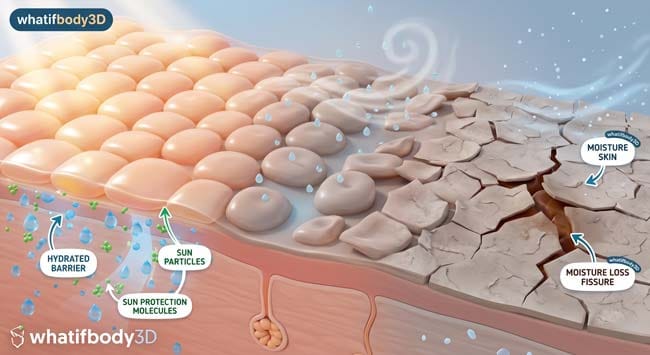
Stage 1: The “Raisin” Effect (Cellular Shrinkage)
At the beginning of the animation, the skin looks plump and bouncy. In the software, I used a Soft-Body Simulation to give the cells a “juicy grape” feel. But as the cold dry air hits in the timeline, we zoom in super close.
My 3D Observation: You can see the skin cells slowly shrinking and flattening. In the viewport, they go from round and full to flat and brittle. It’s a transition from a hydrated sponge to a pile of crunchy cornflakes. It’s a surprisingly violent visual change when you see the volume just… vanish.
This is very similar to the “shriveling” we see in our 3D Organ Shutdown Simulation, where cells lose their internal pressure and collapse inward.
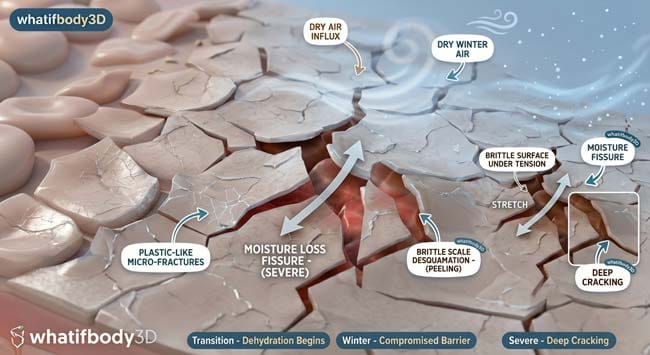
Stage 2: Losing the “Stretch” (Tension Physics)
Normal, healthy skin stretches easily when you smile or move. In our 3D winter simulation, I adjusted the Constraint Settings of the mesh. As the temperature drops, the skin becomes stiff.
When the 3D model tries to smile, the surface resists the movement. Instead of a smooth, elastic stretch, you see tiny Tension Lines appearing. It looks exactly like pulling a piece of old plastic wrap too tight over a bowl.
- The Red Zones: In the stress-test view, the areas around the mouth and eyes turn bright red, indicating that the mesh is about to fail.
- The “Micro-Scream”: While the character is silent, the physics engine shows the “tension war” happening between the underlying muscles and the frozen surface.
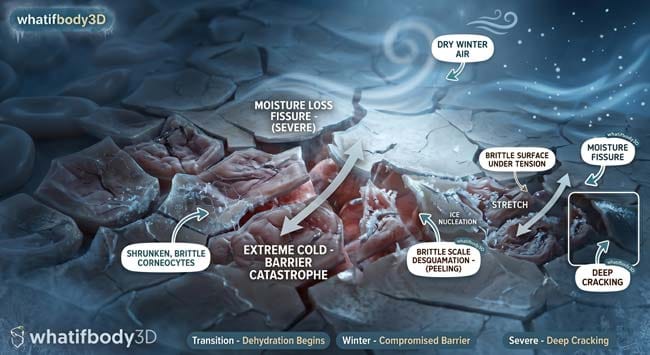
Stage 3: The “Snap” Moment (A Visual Implosion)
This is the part that makes everyone go “OMG.” When the skin is stretched just a fraction more—SNAP! In the close-up 3D animation, you see tiny canyons and cracks suddenly opening up across the surface. It looks like dry earth cracking in a desert, but happening on a human face.
- Visualizing the Fracture: I used a “Cell Fracture” modifier to show where the deeper layers of the dermis become visible through the cracks.
- The “Plastic” Sound: We even added a subtle “cracking” sound effect to emphasize that the skin has lost all biological “give” and has become a brittle material.
Side-by-Side 3D Comparison: Summer vs. Freezing Winter
| Feature | Summer Skin (3D Reference) | Winter “Snap” Skin (Animation) |
| Cell Shape | Round, plump, and “bouncy.” | Flat, brittle, and shriveled. |
| Flexibility | 100% Elasticity; stretches smoothly. | 0% Elasticity; Snaps when stretched. |
| Surface Look | Smooth, glossy, and hydrated. | Rough with visible “canyons” and cracks. |
| Response to Smile | Natural, fluid movement. | Stiff, resisting, and fracturing. |
| Overall Vibe | Soft and “High-Res” healthy. | Stiff and dramatic “Whoa” factor. |
The “Why” Behind the Snap: Science Meets 3D
While our winter skin 3D model uses exaggeration to make cellular changes visible, it is based on the real-world science of the skin barrier, it’s based on the real-world concept of the Skin Barrier. When you lose lipids and water, you lose the “lubricant” that allows your skin cells to slide over one another.
- External Evidence: According to the Mayo Clinic, extreme cold and low humidity lead to a loss of the skin’s protective oils, which can make it feel tight and prone to cracking. Mayo Clinic: Dry Skin Causes and Risk Factors.
- Internal Link: If you think the surface cracking is bad, wait until you see the Brain Shrinkage Visualization, where the entire brain pulls away from the skull due to lack of fluid!
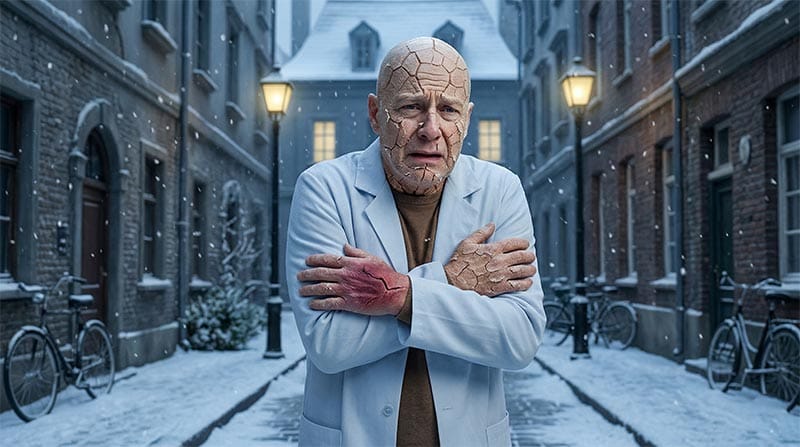
FAQ: The Hidden Secrets of the Winter Snap Animation
Q1: Is this exactly what happens to real skin in winter?
A: No! This is a pure “What If” scenario. Real skin is incredibly tough, but We use exaggerated 3D settings to make microscopic changes visible and easy to understand. It’s an educational visualization of extreme dehydration effects on skin tissue.
Q2: Why does the skin look like “cracked plastic” in 3D?
A: We used a plastic-style shader to highlight the loss of moisture. In the 3D world, when a material doesn’t have “internal fluid,” it behaves like a solid, brittle object. It makes the “snap” much more satisfying to watch!
Q3: What causes the “canyons” in the animation?
A: Those represent Micro-fractures. When the surface layer (the Epidermis) becomes too dry, it can’t handle the movement of the muscles underneath. In our Winter Skin Repair Guide, we explore how the “glue” between these cells fails.
Q4: Is the animation trying to be a horror movie?
A: Not at all! The goal is to make you go “Wow, that looks crazy in 3D!” and enjoy the visual effects. It’s science-fiction applied to human anatomy.
Q5: Can “nugget ice” cause this too?
A: Not to your skin, but it can definitely do it to your teeth! Check out our Chewing Ice 3D Animation to see enamel “snap” under thermal shock.
The Physics of a Cold-Weather “System Failure”
In the viewport, the most interesting part was the Cerebrospinal Fluid of the skin (the interstitial fluid). When I removed the fluid particles, the “mesh” lost its structural support.
My 3D Discovery: Just like a bridge without support beams, the skin mesh eventually collapses under its own weight or the slightest movement. Every smile becomes a “stress event” that could lead to a permanent crack in the render.
- External Evidence: The American Academy of Dermatology (AAD) notes that “cracked” skin is a breach in the body’s armor, allowing bacteria to enter—just like a cracked screen on your phone. AAD: How to treat dry, cracked skin.
Conclusion: Turning the Invisible into the “Whoa”
This was another fun 3D animation exploring a strange “What If” question. We’re animators, not medical professionals—we just love taking the invisible things that happen to your body and turning them into something you can see, enjoy, and share.
Whether it’s skin snapping like plastic or blood turning into sludge, the human body is the coolest machine in the world to animate. Stay curious, stay hydrated, and try to keep your skin “bouncy” this winter!
What “What If” should I animate next? Let me know in the comments!
- Do you want to see a 3D view of what happens when you get “Brain Freeze”?
- Should we animate what happens to your lungs in sub-zero air?
Further Study & External Research
- Healthline: Understanding the Skin Barrier
- ScienceDirect: Biomechanical Properties of Human Skin
Read more on winter skin : What If Your Skin Got Damaged by Winter?
3D Simulation Specs & Observations
| 3D Component | Technical Visual Setting | Observation from Viewport |
| Framerate | 120 FPS High-Speed | Captured micro-movements of the mesh. |
| Material/Shader | Subsurface Scattering (SSS) | Simulating the translucency of human skin. |
| Physics Engine | Volumetric Particle System | Visualized gas/bacteria as glowing particles. |
| Goal | Entertainment / Curiosity | Purely a “What If” hypothetical scenario. |
Pingback: Winter Skin Repair: 7 Amazing Ways to Fix Your Ripped Skin
Pingback: Alcohol-Induced Blackout: 7 Shocking Truths & Why You Forget