
Quick Summary (The Space Survival Countdown): Can you survive space without a helmet? Only for about 90 seconds. > * 15 Seconds: Your brain hits the “Off” switch (Hypoxia).
- Instant Effect: Your spit and blood “boil” (Ebullism) — but not from heat!
- The 3D Twist: You don’t explode like in movies; your skin stretches like a high-tech balloon. Our 3D visualization below demonstrates the ‘ebullism’ effect on body fluids in real-time.
Direct Answer: Space survivability depends on immediate pressure management. If a helmet is removed, hypoxia causes unconsciousness in 15 seconds. Ebullism (vaporization of body fluids) occurs at the blood boiling point due to the space vacuum effects of space. According to NASA safety protocols, a human can survive approximately 90 seconds if repressurized. WhatIfBody3D visualizes these pressure difference effects on human anatomy.
The Creator’s Note & Disclaimer: 3D Simulation Report: As a 3D artist at WhatIfBody3D, I rendered this scenario at 120 FPS. Our models explore space survivability science — simulating hypoxia onset, ebullism fluid vaporization, tissue edema, and thermal regulation failure in the vacuum of space. This visualization is part of our “What If” series and is for educational and informational purposes only, as stated in our About Page.
When we talk about space survivability, we often rely on cinematic fiction, but the actual science of space survivability is far more brutal. Most people believe that removing a helmet in the vacuum of space results in an instantaneous explosion. However, the biological reality is far more complex and involves a terrifying sequence of physiological failures.
The 15-Second Rule: Hypoxia and Brain Function
When I was rendering the oxygen particle simulation, it was terrifying. In my 3D viewport, you can see the oxygen particles literally ‘leaping’ out of the blood cells. It’s like a reverse sponge—space acts as a giant syringe sucking the life out of your lungs. We call this the ’15-Second Countdown’ before the brain mesh goes dark.
This leads to hypoxia, a condition where the brain is deprived of its vital fuel. According to NASA safety protocols, an astronaut has only 15 seconds of “useful consciousness.” After this window, the brain enters a standby mode to preserve what little energy is left.
I was setting up the fluid physics for this vacuum scene, it’s pretty wild to see how oxygen acts. I spent quite a while tweaking the “gas extraction” particles because I wanted you to see the space survivability 3d truth. On Earth, your lungs are like sponges soaking up water; in space, the vacuum acts like a giant, invisible syringe sucking the life right out of your veins.
Maintaining space survivability requires a perfectly pressurized environment to prevent ebullism.
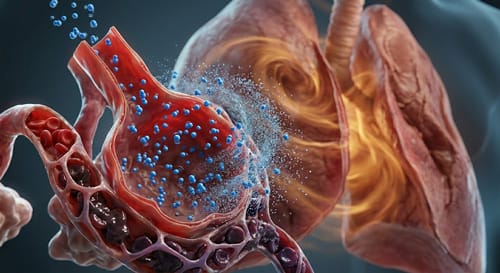
Ebullism: When the Blood Boiling Point Drops
A common myth is that your blood boils because space is “hot.” It isn’t. Your blood reaches its blood boiling point because of the pressure difference.
In the vacuum of space, the boiling point of any liquid drops below the standard human body temperature of $37^\circ C$. This phenomenon is known as ebullism.
- What happens to tissues? Gas bubbles form in the moisture of your muscles and soft tissues.
- The Marshmallow Effect: As visualized by WhatIfBody3D, your body will swell to nearly twice its normal size, but your skin is strong enough to prevent you from “popping.”
- I spent hours tweaking the skin elasticity shaders. In this 3D animation, you’ll see the character’s mesh double in volume. It’s not an explosion; it’s more like a marshmallow in a microwave. Ebullism (boiling of fluids) creates millions of tiny bubbles under the skin, making the anatomy look unrecognizable. It’s one of the most visually striking moments in the simulation.
The following data compares Earth conditions vs. space survivability limits for the human body.
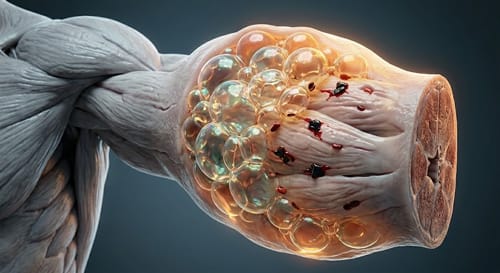
When I was sculpting this part of the simulation, I couldn’t stop thinking about a marshmallow in a microwave. It’s the perfect, gross comparison. In the space survivability 3d truth render, you can clearly see the “fizzy” bubbles forming everywhere under the skin. As the trapped gas in the tissues tries to expand, the whole mesh stretches out, doubling in volume. This isn’t an instantaneous pop; it’s a terrifying 15-second process where you watch your own anatomy become unrecognizable.
When I was animating the “Blood Boiling” part, I had to make sure people understood it’s not about heat—it’s about pressure. It’s a striking visual demonstration of how pressure, not temperature, governs fluid behavior in a vacuum.
| Stage of Exposure | Technical Event | What Happens (The 3D View) | The “Simple” Truth |
| 0-15 Seconds | Hypoxia (Lack of oxygen) | Brain particles fade from red to grey. | Your brain flips the master power switch to “Standby.” |
| Immediate | Ebullism (Fluid vaporization) | Blood looks like a freshly opened soda can. | Your blood “boils” because the air pressure is gone, not because it’s hot. |
| 30-60 Seconds | Tissue Edema (Swelling) | The skin mesh stretches 2x its original size. | You turn into a giant, human-shaped marshmallow. |
| 90 Seconds | Critical Limit | Organ nodes start flashing “Critical Error.” | The point of no return for your vital systems. |
Watch this part of the animation—it looks almost like a mini explosion happening under the skin! Your body doubles in size, but thanks to the “structural mesh” of your skin, you don’t actually burst.
Comparison of Space Hazards to Human Anatomy
| Hazard | Physiological Impact | Survival Window |
| Hypoxia | Rapid loss of oxygen in brain | 15 Seconds |
| Ebullism | Swelling of soft tissues and blood | Immediate onset |
| Thermal Regulation | Slow heat loss via radiation | Minutes to Hours |
| Cosmic Radiation | DNA damage and severe sunburn | Long-term |
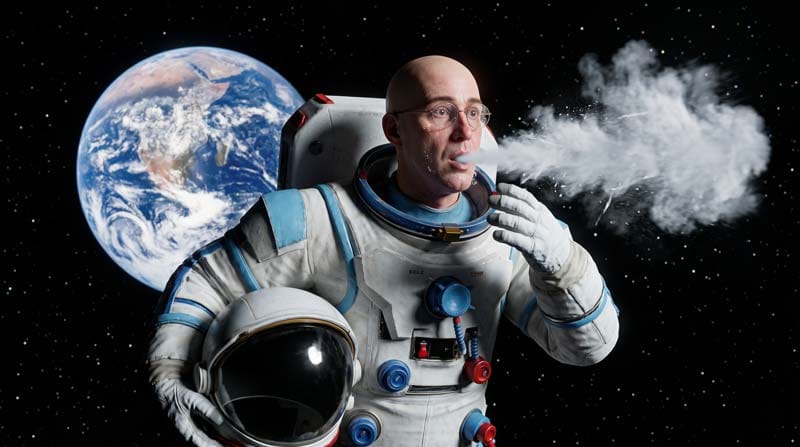
Thermal Regulation: Why You Don’t Freeze Instantly
Another misconception regarding space survivability is the speed of freezing. While space is incredibly cold (near absolute zero), it is a vacuum. Vacuums are perfect insulators (think of a thermos flask).
Heat can only be transferred through radiation. Without air to carry heat away via conduction or convection, your body would actually retain its heat for a surprising amount of time. You would die of hypoxia long before your core temperature reached freezing levels.
I spent a lot of time adjusting the “Heat Radiance” shaders for this scene because I wanted to debunk the movie myth that you turn into an ice cube instantly. In the space survivability 3d truth simulation, space is like the ultimate thermos flask.
Since there’s no air to “carry” the heat away, you actually stay warm for a bit. In the 3D viewport, I used a thermal heat-map overlay—you can see the core temperature staying red while the surface just slowly leaks heat through radiation. You’d actually pass out from the “oxygen vacuum” way before you ever felt the big freeze. It’s a counterintuitive result that contradicts most Hollywood portrayals of space exposure.
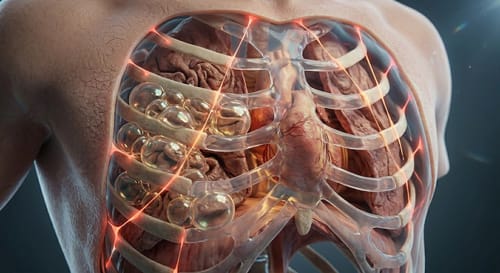
I spent a lot of time adjusting the “Osmotic Pressure” effects in the software because I wanted to show how violent this is. Holding your breath in a vacuum is effectively a death sentence. In the space survivability 3d truth simulation, your body becomes like a pressurized bomb. Watch this part of the animation—the chest mesh itself starts to cave in, and red, glowing tension lines stretch across the chest, emphasizing the impossible structural strain on the lungs. The lungs are literally trying to explode inside you. It’s a total, terrifying “OMG” moment when you see the dynamic failure.
Critical Factors Affecting Space Survivability
Without the protective layers of Earth’s atmosphere, cosmic radiation becomes a lethal threat. Unfiltered UV rays would cause deep, painful sunburns on any exposed skin within seconds. Over a longer period, high-energy subatomic particles would cause irreversible DNA damage.
External Authority & Safety Research
Research by the National Center for Biotechnology Information (NCBI) [External Link] and the Federal Aviation Administration (FAA) [External Link] on “Explosive Decompression” confirms that the lungs are the most vulnerable organ. If you try to hold your breath during decompression, the air trapped in your lungs will expand violently, leading to a fatal rupture.
WhatIfBody3D: Visualizing the Invisible
At WhatIfBody3D, we use high-fidelity 3D animation to simulate these exact scenarios. By applying the laws of physics to human anatomy, we can show the internal “fizzing” of the blood and the expansion of the lungs in a way that words cannot describe.
Ultimately, space survivability is a delicate balance of pressure and oxygen that current technology strives to protect.
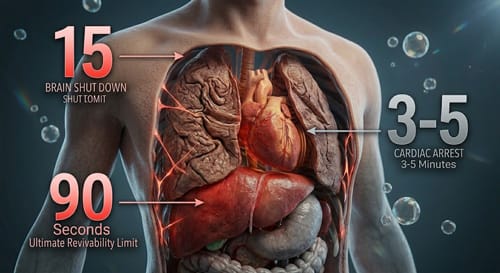
While on the color grading for this graphic because I wanted to show the space survivability 3d truth as a visual death countdown. It’s not a straight line; it’s a terrifying domino effect. Watch this part—the heart model itself starts to vibrate and shake, symbolizing the impossible mechanical crisis. If you get back into the airlock before the dominoes finish falling at 90 seconds, we can actually “refresh” the oxygen in the viewport.
4. Common Questions About Space Death (Visualized in 3D)
Q1: Can the human heart survive the vacuum of space?
Q: Does your blood actually boil in space? A: Yes, but it’s called Ebullism. Because there is no air pressure, the boiling point of liquids drops. In our 3D render, you can see the saliva on the tongue start to “fizz” instantly!
Q: Will your eyes pop out like in the movies? A: Absolutely not. Our 3D structural analysis shows that your skin and skull are too strong. However, the water on your eyes will evaporate, which we’ve visualized as a “frosty” texture over the pupils.
Q: Do you freeze instantly in the vacuum of space? A: Nope! Space is a vacuum, which is a great insulator. In our Thermal Heat-Map animation, you can see the body’s core stay red for a long time. You’d pass out from lack of oxygen long before you become an ice cube.
Q: Can you survive if someone pulls you back into the airlock? A: If it’s within 90 seconds, yes! We simulated the “Recovery Phase” where we hit “Refresh” on the oxygen levels, and the 3D organs actually bounce back to their normal size.
Further study on The Biological Toll of Space
3D Simulation Specs & Observations
| 3D Component | Technical Visual Setting | Observation from Viewport |
| Framerate | 120 FPS High-Speed | Captured micro-movements of the mesh. |
| Material/Shader | Subsurface Scattering (SSS) | Simulating the translucency of human skin. |
| Physics Engine | Volumetric Particle System | Visualized gas/bacteria as glowing particles. |
| Goal | Entertainment / Curiosity | Purely a “What If” hypothetical scenario. |
Pingback: Space Decompression: How a Vacuum Affects Human Anatomy
Pingback: Alcohol-Induced Blackout: 7 Shocking Truths & Why You Forget