
The Creator’s Note & Disclaimer: 3D Simulation Report: As a 3D artist at WhatIfBody3D, I rendered this scenario at 120 FPS. Our models explore brain damage from drinking — simulating excitotoxicity at the synaptic level, blood-brain barrier breach, hippocampal atrophy, and Wernicke-Korsakoff syndrome progression. This visualization is part of our “What If” series and is for educational and informational purposes only, as stated in our About Page.
Quick Answer: What is Brain Damage From Drinking? (The Atomic Answer)
Does blacking out cause permanent brain damage from drinking? Yes. It is a state of acute neurotoxicity where your brain cells are chemically “drowned” and fail to communicate.
- The “Animal Mode”: When you black out, your Prefrontal Cortex (logic) and Hippocampus (memory) go dark, leaving your Amygdala (rage/fear) in total control.
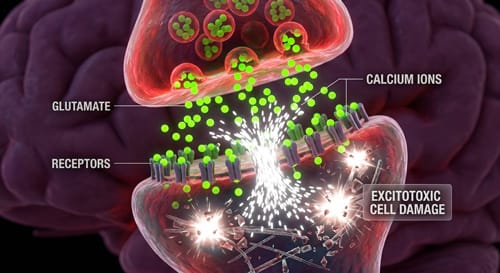
- Excitotoxicity: After the alcohol leaves, your neurons become “over-excited” and literally work themselves to death, creating “mini-explosions” at the synaptic level.
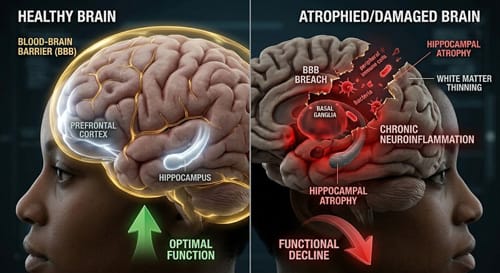
- Brain Shrinkage: Chronic blackouts lead to Cerebral Atrophy, where the brain physically shrivels, and the Blood-Brain Barrier (your VIP security) is breached.
- The “Auto-Pilot” Trap: You look “fine” because your motor skills are still on, but your human moral compass has physically left the building.
My 3D Discovery: Watching the “Human Brain” Go Offline
Honestly, when I was tweaking the 3D scene for this part, it was striking to observe In my software, I created a high-resolution anatomical model. I rendered the Prefrontal Cortex in a dull, deactivated gray with a glowing red “OFF” power icon hovering over it.
3D Observation: It’s like watching a house where the lights are out in the living room, but there’s a riot happening in the basement. The Amygdala and Basal Ganglia (the “Animal Brain”) emit an ominous red pulse in the render. This is the neurological reality: your prefrontal logic center is physically deactivated, and you are literally on “Auto-Pilot.”
This is just as terrifying as the Alcohol-Induced Blackout Science we explored previously—it’s a total system failure.
Stage 1: Excitotoxicity (The “Synaptic Burnout”)
Does a blackout cause brain damage from drinking? The short answer is yes. Ethanol is a small molecule that easily kicks down the door of the Blood-Brain Barrier (BBB). Once inside, it triggers a violent process called Excitotoxicity.
In our 3D model, I visualized this as a mini-explosion at the synaptic level.
- The Rebound: Because alcohol suppressed your receptors all night, your brain compensated by creating more. When the alcohol leaves, these receptors are suddenly flooded with Glutamate.
- The Burnout: I spent quite a while getting that “burn out” effect right—it looks like the neurons are being “zapped” by their own signals. High concentrations of Calcium Ions (rendered as intense white light) rush into the cell, triggering spark-like explosions.
- External Evidence: According to the American Heart Association (AHA), excessive alcohol is a leading cause of preventable neurodegeneration. AHA: How Alcohol Affects Your Heart and Brain.
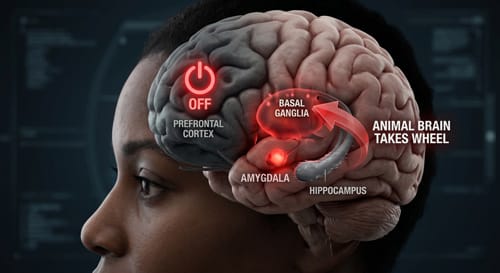
Table 1: Alcohol’s Impact on Different Brain Regions (3D Breakdown)
| Brain Region | Normal Function (3D View) | Effect During Blackout | Long-term Damage Risk |
| Hippocampus | Glowing “Save” button. | Total Recording Shutdown. | Hippocampal Atrophy (Shrinkage). |
| Prefrontal Cortex | Logic & Moral compass. | Dark/Inactive. | Permanent Cognitive Impairment. |
| Amygdala | Emotional Balance. | Hyperactive Red Pulse. | Aggression & Rage Disorders. |
| Blood-Brain Barrier | Golden “VIP” Shield. | Fragmented & Torn. | Chronic Neuroinflammation. |
| Cerebellum | Smooth Coordination. | The “Drunk Stumble”. | Permanent Gait Issues. |
Stage 2: The BBB Breach (The Security Leak)
One of the most haunting parts of my 3D render was the Blood-Brain Barrier (BBB) Breach. Think of the BBB as a VIP velvet rope protecting your brain.
My 3D Observation: In the animation, the ethanol molecules rapidly compromise the integrity of. Once that gate is open, all toxins and peripheral immune cells from your bloodstream (toxins, red peripheral immune cells) leaks into your gray matter. This is why you feel that heavy “brain fog” for days—your brain’s immune cells (Microglia) are desperately trying to clear the chemical debris.
This internal “trash leak” is a primary driver of brain damage from drinking. It’s similar to the toxic buildup we see in the Stop Drinking Water Organ Shutdown—the body simply cannot flush the poison out fast enough.
Stage 3: Wernicke-Korsakoff Syndrome (The “Glitchy” Brain)
If you continue to push your brain to the limit, you risk Wernicke-Korsakoff Syndrome (colloquially known as “Wet Brain”). This is a permanent state of memory loss caused by severe Thiamine (Vitamin B1) deficiency.
In the 3D short, I showed these memories flickering like a glitchy VHS tape.
- Confabulation: The brain knows it has a hole in its memory, so it panics and “photoshops” a fake one in.
- The Reality: The person isn’t lying; their brain is malfunctioning so badly it can no longer tell truth from fiction. It’s one of the most haunting things to visualize—a brain that can’t trust its own past.
- External Evidence: The Mayo Clinic highlights that chronic alcohol use can lead to permanent brain damage if nutritional deficiencies aren’t addressed.

FAQ: Brain Damage & Blackout Risks (USA Search Trends)
Q1: Is blacking out the same as a concussion?
A: Chemically, yes. Both involve a “metabolic crisis” where the brain’s energy demand exceeds its supply. While a concussion is physical trauma, a blackout causes significant brain damage from drinking through chemical “burnout.”
Q2: Why do I repeat myself 10 times during a blackout?
A: Your Short-term Memory (the 90-second “RAM” buffer) is actually still working, but the “Save to Hard Drive” function is broken. You literally don’t remember that you just asked the same question 2 minutes ago.
Q3: Can the brain heal from blackout-induced damage?
A: The brain has a degree of Neuroplasticity. After 30 days of total abstinence, white matter volume begins to restore. However, the loss of actual neurons (cell death) is often permanent.
Q4: Does “tolerance” protect you from brain damage?
A: No. High tolerance just means your brain has adapted to functioning while poisoned. The neurotoxicity at the cellular level is still happening, and often, high-tolerance drinkers suffer more damage because they drink larger quantities.
Q5: What is “Hypoxia” during a blackout?
A: Hypoxia occurs when alcohol slows your breathing so much that your brain doesn’t get enough oxygen. This is a primary cause of fatal brain damage during severe alcohol poisoning.
Q6: Can 3D scans see the brain “shrink”?
A: Absolutely. Using 3D MRI tech, we can see Cerebral Atrophy—the brain actually shrivels like a piece of dried fruit. You can see this visual horror in our Brain Shrinkage Guide.
Expert Advice: How to Protect Your “Architecture”
To minimize brain damage from drinking, experts in the States recommend the 0-1-3 Rule:
- 0 drinks if you are driving.
- 1 drink per hour to allow the liver to keep up.
- Never more than 3 drinks per occasion.
Fun Ways to Get the “Crunch” Without the Drama:
Many are pivoting to “Mocktails” with high-dose B-Complex supplements. While Thiamine (B1) and Magnesium can help support neural repair, they aren’t a “get out of jail free” card. The only way to stop the “synaptic mini-explosions” is to stop the chemical flood.
Conclusion: Don’t Let Your Human Brain Leave the Building
Every time you black out, you are performing a dangerous, high-stakes experiment on your nervous system. The “missing hours” are a physical manifestation of your Hippocampus failing under toxic stress.
- The Reality: Brain damage from drinking isn’t just something that happens to “long-term addicts”—it starts with the very first blackout.
- The 3D Visual Truth: When those neural signals fail to jump the gap, your architecture is being dismantled.
What “What If” should I animate next? Let me know in the comments!
- Do you want to see a 3D view of “Alcoholic Fatty Liver”?
- Should we animate how caffeine masks a blackout?
Further Study & External Research
- NIAAA: Alcohol’s Effects on the Brain
- National Kidney Foundation: How Alcohol Affects Your Organs
Find out more about Alcohol-Induced Blackout
3D Simulation Specs & Observations
| 3D Component | Technical Visual Setting | Observation from Viewport |
| Framerate | 120 FPS High-Speed | Captured micro-movements of the mesh. |
| Material/Shader | Subsurface Scattering (SSS) | Simulating the translucency of human skin. |
| Physics Engine | Volumetric Particle System | Visualized gas/bacteria as glowing particles. |
| Goal | Entertainment / Curiosity | Purely a “What If” hypothetical scenario. |
Pingback: Alcohol-Induced Blackout: 7 Shocking Truths & Why You Forget
Pingback: Brain Toxins Sleep Deprivation: 5 Ways Your Brain Detox Fails