
The Creator’s Note & Disclaimer: As a 3D artist at WhatIfBody3D, I rendered this scenario at 120 FPS. Our models explore what happens if you inhale a bug — visualizing nasal cavity defense systems, cilia mechanics, mucosal barrier response, and the body’s emergency foreign object removal protocols. This visualization is part of our “What If” series and is for educational and informational purposes only, as stated in our About Page.
Quick Answer: What Happens If You Inhale a Bug? (The Atomic Answer)
What happens if you inhale a bug while sleeping? Your body has a remarkably sophisticated defense system specifically designed for exactly this scenario — and it activates within milliseconds.
- The First Line: Your nasal cavity is lined with mucus-coated cilia — microscopic hair-like structures that trap foreign objects and transport them back toward the throat within minutes. A bug inhaled through the nose almost never reaches the lungs.
- The Alarm System: Specialized sensory neurons in the nasal lining detect the foreign object and trigger an immediate sneeze reflex — generating an airflow of up to 100 mph to expel the intruder.
- The Backup System: If the object passes the nasal cavity and reaches the airway, the cough reflex activates — producing expulsive airflows of up to 500 mph at the glottis.
- The Reality: The vast majority of inhaled insects are trapped by nasal mucus, transported by cilia, swallowed, and digested without you ever being aware it happened. The fear is real — the danger is minimal for healthy adults.

My 3D Discovery: Rendering the “Bug Trap” Inside Your Nose
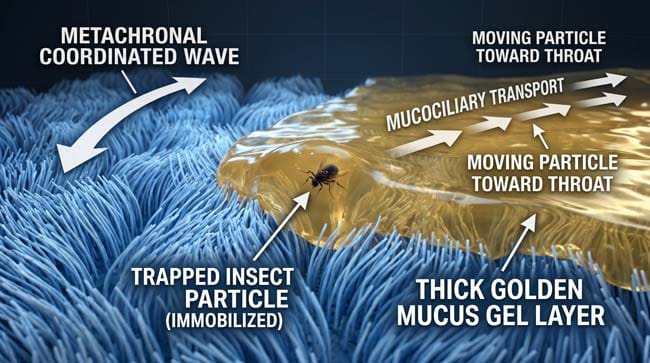
When I was setting up the nasal cavity model for this simulation, the most visually striking element was the cilia field. In the 3D viewport, the nasal lining is covered in an extraordinary density of cilia — approximately 200 cilia per cell, with millions of cells lining the nasal passage. The combined surface looks like a microscopic forest of constantly moving filaments, all beating in coordinated waves toward the throat.
When I introduced the bug particle into this environment, the response was immediate and systematic. The mucus layer engulfed the object within seconds. The cilia beneath began their coordinated beating — moving the mucus blanket, and everything trapped in it, steadily toward the pharynx.
3D Observation: The most visually compelling sequence in this simulation is the coordinated cilia beat. Each individual cilium beats in a forward power stroke, then recovers in a slower backward stroke — the timing offset between adjacent cells creates a visible wave pattern that propagates continuously toward the throat. In the animation, the trapped bug particle moves visibly along this mucociliary escalator — steadily, inevitably, toward the exit. The system requires no conscious activation. It runs continuously, 24 hours a day, processing everything the nasal cavity captures.
Stage 1: The Nasal Cavity — Nature’s Bug Filter
Your nasal cavity is not simply a passage for air. It is a sophisticated filtration and defense system that processes approximately 10,000 liters of air per day — and everything suspended in that air.
The Three Defense Layers:
Layer 1 — Nasal Hair (Vibrissae) The coarse hairs at the entrance to the nostrils provide the first mechanical barrier. In our 3D model, I rendered the vibrissae as thick, irregularly spaced fibers that create a physical mesh. Large insects — anything above approximately 1–2mm — are typically intercepted at this level, triggering an immediate sneeze reflex before they can travel deeper.
Layer 2 — Mucus Layer Beyond the vibrissae, the nasal cavity walls are coated in a two-layer mucus system:
- Sol layer (inner, watery) — allows cilia to move freely
- Gel layer (outer, sticky) — traps particles, bacteria, and foreign objects
In the 3D model, I showed the gel layer as a viscous golden surface that deforms around the bug particle on contact — trapping it like an insect in amber. The bug cannot move forward. It is immediately immobilized by the mucus.
Layer 3 — Mucociliary Escalator Beneath the mucus, approximately 6 billion cilia line the nasal cavity and respiratory tract. Each cilium is 5–10 micrometers long and beats at 10–15 times per second in coordinated metachronal waves — moving the overlying mucus layer (and everything trapped in it) at a rate of 4–20mm per minute toward the throat.
In the simulation, I visualized this as a moving carpet — the bug particle, trapped in mucus, being steadily transported backward toward the pharynx regardless of whether the person is breathing in or out.
| Defense Layer | Location | 3D Visualization | Effectiveness |
|---|---|---|---|
| Nasal hair (vibrissae) | Nostril entrance | Thick fiber mesh | Stops large particles (>1–2mm) |
| Mucus gel layer | Entire nasal lining | Golden viscous trapping surface | Captures particles of all sizes |
| Mucociliary escalator | Nasal and respiratory lining | Coordinated wave motion carpet | Transports trapped material to pharynx |
| Sneeze reflex | Triggered by sensory neurons | Explosive airflow visualization | Emergency expulsion at 100 mph |
According to the American Academy of Allergy, Asthma and Immunology (AAAAI), the mucociliary escalator clears particles from the nasal cavity at a rate of approximately 4–20mm per minute — meaning a particle trapped in the nasal cavity is typically transported to the throat and swallowed within 10–20 minutes of initial capture. AAAAI: Nasal Mucociliary Clearance
Stage 2: The Sneeze Reflex — Emergency Expulsion Protocol
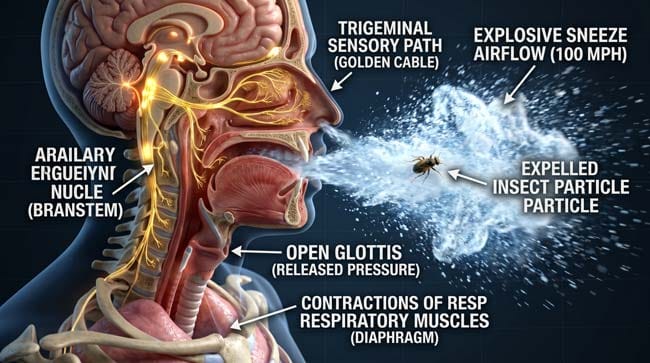
If the inhaled bug reaches the sensory nerve endings in the nasal lining before being captured by mucus, the sneeze reflex activates. This is one of the most powerful automated responses in the human body — and in our 3D simulation, it is the most visually dramatic sequence.
The Sneeze Reflex Pathway:
Step 1 — Sensory Detection (0 milliseconds) Specialized sensory neurons — trigeminal nerve fibers — line the nasal mucosa. When a foreign object contacts these fibers, they fire an immediate signal to the sneeze center in the brainstem (located in the lateral medullary reticular formation).
In the 3D model, this signal appears as a bright electrical pulse traveling along the golden trigeminal nerve from the nasal cavity to the brainstem — reaching the sneeze center in approximately 50 milliseconds.
Step 2 — Preparatory Phase (0–1 second) The sneeze center coordinates a complex preparatory response:
- Deep inhalation — shown as the diaphragm and chest muscles expanding dramatically
- Glottis closes — vocal cords shown sealing the airway
- Intrathoracic pressure builds — shown as pressure accumulating in the lungs and chest cavity
Step 3 — Expulsive Phase (1–2 seconds) The glottis opens suddenly. The diaphragm and chest muscles contract explosively. In our 3D simulation, this produces the most visually striking moment — a massive airflow particle system erupting from the nose at up to 100 mph (160 km/h), carrying the trapped foreign object with it.
Step 4 — Droplet Cloud (Ongoing) The sneeze also produces a cloud of respiratory droplets — shown as thousands of tiny sphere particles in the simulation — that can travel up to 26 feet from the sneezer. Each droplet potentially carries trapped particles, bacteria, and viruses from the nasal cavity.
| Sneeze Phase | Duration | 3D Visual | Physical Event |
|---|---|---|---|
| Sensory detection | 0–50ms | Trigeminal nerve pulse | Bug contacts nasal sensory neurons |
| Deep inhalation | 0.5–1 sec | Diaphragm expanding | Pressure build-up phase |
| Glottis closure | Instantaneous | Vocal cords sealing | Pressure containment |
| Expulsive release | 0.1–0.2 sec | 100 mph airflow particle system | Bug expelled from nasal cavity |
| Droplet cloud | 1–2 sec | Thousands of droplet particles | Secondary aerosol production |
Stage 3: What Happens If the Bug Gets Past the Nose
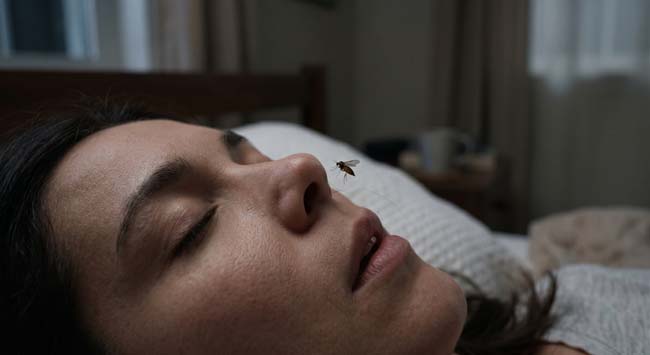
In rare cases — particularly during deep sleep when reflex responses are suppressed — a small insect might travel past the nasal cavity toward the pharynx, larynx, or even the trachea. In our simulation, I modeled this extended pathway to show what defense systems activate at each level.
The Pharynx (Throat) If the bug reaches the throat, the gag reflex activates — a protective response coordinated by the glossopharyngeal and vagus nerves. In the 3D model, contact with the posterior pharyngeal wall triggers immediate involuntary contraction of the pharyngeal muscles — attempting to expel the foreign object upward.
Additionally, the bug is now in position to be swallowed — entering the esophagus and eventually the stomach, where gastric acid (pH 1.5–3.5) destroys any biological material completely.
The Larynx (Voice Box) The larynx has the most sensitive foreign body detection system in the airway. Laryngeal sensory receptors — innervated by the superior laryngeal nerve — are extraordinarily sensitive to contact. Even a tiny particle touching the laryngeal mucosa triggers an immediate, powerful cough reflex.
The Cough Reflex: More powerful than the sneeze, the cough generates airflow velocities of up to 500 mph (800 km/h) at the glottis — among the fastest air velocities produced by any biological process. In our 3D simulation, the cough is shown as an explosive pressure wave that dwarfs the sneeze in intensity, propelling any foreign object from the larynx back into the pharynx.
The Trachea and Bronchi If a particle somehow reaches the trachea, the mucociliary escalator continues — cilia in the tracheal and bronchial lining beat upward toward the throat, transporting trapped material back toward the pharynx within minutes to hours.
The Lungs (Alveoli) If a very fine particle reaches the alveoli (air sacs), alveolar macrophages — immune cells that continuously patrol the lung surface — engulf and destroy it. In the 3D model, these appear as large rounded cells that flow across the alveolar surface, engulfing foreign particles through phagocytosis.
| Airway Level | Defense Mechanism | Response Speed | Effectiveness |
|---|---|---|---|
| Nasal cavity | Mucociliary escalator + sneeze | Seconds to minutes | ✅ Stops >99% of particles |
| Pharynx | Gag reflex + swallowing | Milliseconds | ✅ Very effective |
| Larynx | Cough reflex (500 mph) | Milliseconds | ✅ Extremely effective |
| Trachea/Bronchi | Mucociliary escalator (upward) | Minutes to hours | ✅ Effective for larger particles |
| Alveoli | Alveolar macrophages | Hours | ✅ Effective for fine particles |
According to the National Heart, Lung, and Blood Institute (NHLBI), the mucociliary clearance system in the respiratory tract processes and removes inhaled particles continuously — with healthy individuals clearing most particles from the upper airway within 30–60 minutes through mucociliary transport and reflex mechanisms. NHLBI: Respiratory Defense Mechanisms
FAQ: What Happens If You Inhale a Bug?
Q1: Is it common to inhale bugs while sleeping? More common than most people realize. Studies of inhaled foreign body incidents suggest that insects — particularly small flying insects like gnats, fruit flies, and mosquitoes — are among the most frequently inhaled foreign objects. However, because the nasal defense system handles them so effectively, most people are never aware it happened. The bug is trapped, transported, swallowed, and digested without producing any memorable symptoms.
Q2: Can an inhaled bug lay eggs inside your nose? This is one of the most persistent fears associated with bug inhalation — and in healthy people with intact immune systems, it is essentially impossible. The nasal mucociliary system transports foreign objects out within minutes, the mucus environment is hostile to most insect eggs, and the immune system would respond aggressively to any biological material attempting to establish itself. Documented cases of nasal myiasis (fly larvae in nasal tissue) are extremely rare and involve specific circumstances — typically open wounds or severe immunocompromise, not casual bug inhalation.
Q3: Why do people sometimes feel like a bug is still in their nose hours after inhaling one? The sensory neurons in the nasal lining remain sensitized after a foreign body contact — similar to how your eye continues to feel irritated after a particle is removed. The bug is almost certainly gone within minutes, transported by the mucociliary escalator. The persistent feeling is neurological aftereffect, not continued physical presence.
Q4: What should I do if I think I inhaled a bug that is still in my airway? For adults, allowing the body’s natural defense mechanisms to work is almost always sufficient — the mucociliary system will transport the bug within minutes to hours, and it will either be expelled through sneezing, coughing, or swallowed. If you experience persistent coughing, difficulty breathing, chest pain, or symptoms that do not resolve within a few hours, seek medical evaluation. These symptoms may indicate the object reached deeper into the airway than typical.
Q5: Do bugs feel pain when inhaled into a human nose? Insect neurobiology is an active area of research. Current scientific consensus suggests insects have nociceptors (pain-detecting neurons) and may experience something analogous to pain, but their nervous systems are significantly simpler than vertebrates. An insect trapped in nasal mucus would be immobilized rapidly and exposed to the mucosal immune environment — the experience, whatever it is, would be brief.
Conclusion: The Most Underappreciated Defense System in Your Body
The nasal cavity’s defense mechanisms — the mucociliary escalator, the sneeze reflex, the layered mucus system — represent one of the most elegantly engineered filtration systems in biology. Processing 10,000 liters of air per day, capturing particles as small as bacteria, and transporting them systematically toward expulsion without any conscious effort.
In 3D, rendering the mucociliary escalator — the coordinated beating of billions of cilia creating a visible transport wave that moves everything from tiny bacteria to an unlucky gnat steadily toward the throat — is one of the most visually satisfying sequences in this simulation series.
You inhale bugs regularly. Your body handles it without complaint, without conscious awareness, and without any need for intervention. The fear of inhaling an insect is understandable — the biological reality is considerably less dramatic than the imagination suggests.
Further Study & External Research
3D Simulation Specs & Observations
| 3D Component | Technical Visual Setting | Observation from Viewport |
|---|---|---|
| Framerate | 120 FPS High-Speed | Captured cilia beat mechanics and sneeze airflow dynamics |
| Material/Shader | Subsurface Scattering (SSS) | Simulating nasal mucosal tissue translucency and mucus viscosity |
| Physics Engine | Volumetric Particle System + Fluid Dynamics | Visualized cilia wave motion, mucus transport, and sneeze airflow |
| Goal | Educational / Science Visualization | Research-referenced 3D breakdown of nasal defense system response to inhaled insects |
Read more on How Does Your Body Remove Inhaled Particles?
Pingback: How Does Your Body Remove Inhaled Particles? 3D Science