
The Creator’s Note & Disclaimer: As a 3D artist at WhatIfBody3D, I rendered this scenario at 120 FPS. Our models explore Red Bull’s effects on the heart and brain — visualizing caffeine’s cardiac electrophysiology, taurine’s neurological modulation, adenosine receptor dynamics, and the cardiovascular stress mechanics of high-volume energy drink consumption. This visualization is part of our “What If” series and is for educational and informational purposes only, as stated in our About Page.
Quick Answer: What Are Red Bull’s Effects on Heart and Brain? (The Atomic Answer)
Red Bull effects on heart and brain begin within 15–45 minutes of consumption and involve a cascade of molecular events that simultaneously alter cardiac electrophysiology, neurotransmitter balance, and vascular tone.
- The Brain: Caffeine blocks adenosine receptors — preventing the brain’s fatigue signal from being received. Simultaneously, blocked adenosine triggers elevated dopamine and norepinephrine release — producing the characteristic alertness, focus, and mild euphoria.
- The Heart: Caffeine increases heart rate through sympathetic nervous system activation and direct effects on cardiac pacemaker cells. Taurine modulates calcium ion channels in cardiac muscle — affecting contraction strength and rhythm regularity.
- The Blood Vessels: Caffeine causes initial vasoconstriction — narrowing blood vessels and raising blood pressure. This effect is measurable within 30 minutes of a single can and persists for 3–5 hours.
- The Crash: As caffeine is metabolized, adenosine — which has continued accumulating during the blocked period — floods suddenly unblocked receptors simultaneously, producing the characteristic energy crash that is significantly deeper than baseline fatigue.
My 3D Discovery: Rendering the “Electrical Storm” in Your Heart
When I was building the cardiac electrophysiology model for this simulation, the most technically fascinating visualization was showing how caffeine affects the heart’s electrical system at the cellular level. The heart’s rhythm is controlled by ion channels — protein gates in cardiac cell membranes that control the flow of sodium, potassium, and calcium ions.
In the 3D viewport, I rendered each ion channel as a distinct gated pore in the cell membrane — sodium channels shown as blue gates, potassium channels as green gates, calcium channels as red gates. Under normal conditions, these channels open and close in a precisely coordinated sequence — producing the action potential that triggers each heartbeat.
Caffeine shown as interfering with this choreography — particularly by sensitizing calcium release from the sarcoplasmic reticulum. In the animation, calcium shown flooding into cardiac cells at slightly elevated levels — making each contraction more forceful and the pacemaker cells firing more frequently.
3D Observation: The most visually striking moment in this cardiac simulation is the action potential comparison — normal heartbeat versus post-Red Bull heartbeat. Normal rhythm shown as smooth, regular peaks on the cardiac electrical trace. After Red Bull, the action potential shown as slightly higher amplitude, shorter cycle length, and in some cardiac cell types, additional spontaneous depolarization events — shown as small extra spikes between normal beats. These extra depolarizations are the cellular basis of the palpitations many people notice after high-caffeine consumption.
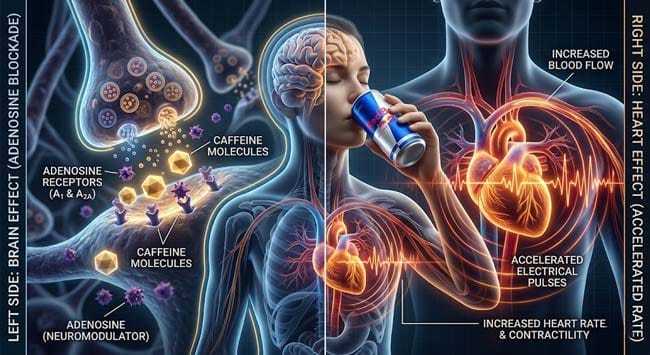
Stage 1: Red Bull’s Effects on the Brain — The Neurochemical Cascade
The Adenosine System — Your Brain’s Fatigue Clock
To understand Red Bull’s brain effects, you must first understand adenosine — the molecule that caffeine is designed to block.
Adenosine is an inhibitory neuromodulator produced continuously as a byproduct of neuronal activity. As neurons fire throughout your waking hours, adenosine accumulates — binding to A1 and A2A adenosine receptors throughout the brain. The more adenosine binds, the more inhibited your neural activity becomes — producing progressively increasing fatigue, slowed reaction time, and eventually drowsiness.
In our 3D brain model, I rendered this accumulation as a progressive dimming of neural activity — bright synaptic connections gradually dimming as adenosine receptors fill over a 16-hour waking period.
Caffeine’s Molecular Intervention:
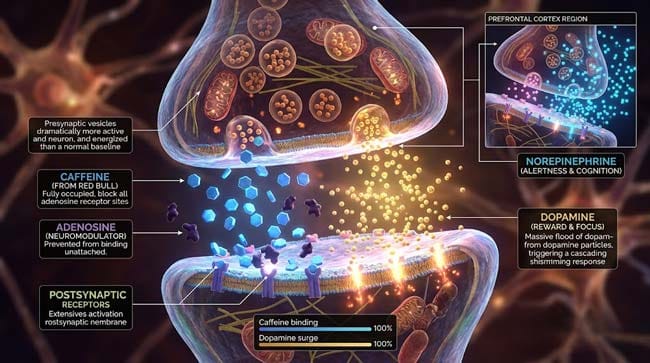
Caffeine’s molecular structure closely resembles adenosine — close enough to occupy adenosine receptor binding sites without activating them. In the simulation, caffeine molecules shown as slightly different-shaped keys that fit into the adenosine receptor lock but cannot turn it — occupying the receptor and preventing real adenosine from binding.
The Downstream Effects of Adenosine Blockade:
Dopamine System Activation Adenosine normally inhibits dopamine release. With adenosine blocked, dopamine neurons shown releasing elevated dopamine into reward pathway synapses — particularly in the nucleus accumbens and prefrontal cortex. This dopamine elevation produces the motivational, focused, pleasant feeling associated with caffeine.
Norepinephrine Release The locus coeruleus — the brain’s primary norepinephrine production center — is also disinhibited by adenosine blockade. Shown in the animation as increased norepinephrine release into the prefrontal cortex — enhancing attention, working memory, and vigilance.
Acetylcholine Enhancement In the hippocampus, adenosine blockade shown enhancing acetylcholine activity — contributing to the improved short-term memory and learning consolidation some people report after moderate caffeine.
The Complete Neurotransmitter Effect of One Red Bull:
| Neurotransmitter | Normal State | Post-Red Bull State | 3D Visualization | Experienced Effect |
|---|---|---|---|---|
| Adenosine | Accumulating, causing fatigue | Blocked from receptors | Dark particles bouncing off occupied receptors | Fatigue signal eliminated |
| Dopamine | Normal baseline | Elevated 20–30% | Golden particles flooding reward synapses | Motivation, mild euphoria |
| Norepinephrine | Normal baseline | Elevated | Blue particles increasing in prefrontal cortex | Focus, alertness, vigilance |
| Acetylcholine | Normal baseline | Mildly elevated | Green particles enhanced in hippocampus | Improved memory function |
| GABA | Normal inhibitory tone | Reduced | Fewer inhibitory signals | Reduced anxiety threshold |
The Taurine Factor — Brain Modulation
Taurine (1,000mg per can) is a sulfur-containing amino acid that acts as a neuromodulator — modulating GABA-A receptor activity and reducing neuronal excitability. In the 3D model, taurine shown as partially counteracting some of caffeine’s excitatory effects — creating a more balanced stimulation than caffeine alone would produce.
This taurine-caffeine interaction is thought to be why Red Bull produces a somewhat smoother stimulation profile than equivalent pure caffeine — the taurine modulating the peak excitatory effect.
According to the National Institutes of Health (NIH), caffeine’s adenosine receptor blockade is the primary mechanism responsible for its cognitive effects, with the magnitude of effect correlating directly with individual adenosine receptor density — explaining why caffeine sensitivity varies dramatically between individuals. NIH: Caffeine and Adenosine Receptor Pharmacology
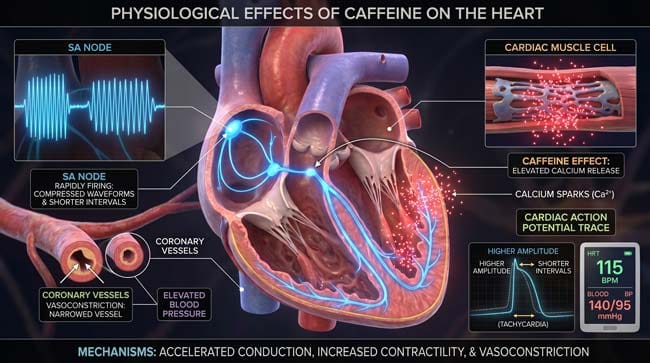
Stage 2: Red Bull’s Effects on the Heart — Cardiac Electrophysiology
The Heart’s Electrical System
The heart generates its own electrical rhythm through a network of specialized cells — the sinoatrial (SA) node, atrioventricular (AV) node, and Purkinje fiber system. In our 3D cardiac model, I rendered this electrical system as a glowing network of conduction pathways — the electrical impulse shown traveling from the SA node downward through the heart with each beat.
How Caffeine Affects Each Component:
SA Node — The Pacemaker The SA node sets the heart’s baseline rate. Caffeine affects SA node firing rate through two mechanisms:
- Direct cAMP elevation — caffeine inhibits phosphodiesterase enzymes that break down cAMP (cyclic AMP). Elevated cAMP increases SA node firing rate — shown as the pacemaker cell action potential cycle length decreasing, producing faster heart rate.
- Sympathetic activation — caffeine-induced norepinephrine release from the adrenal glands shown arriving at cardiac beta-1 adrenergic receptors — further increasing heart rate and contractile force.
In the simulation, normal SA node firing shown as regular 60–75 beats per minute. Post-Red Bull, shown as 75–90+ beats per minute — the pacemaker cycling faster under combined cAMP and sympathetic stimulation.
Calcium Channel Sensitization Caffeine sensitizes the ryanodine receptor — the calcium release channel in the sarcoplasmic reticulum of cardiac muscle cells. In the 3D calcium dynamics model:
- Normal state: calcium released from SR in precise, controlled amounts with each action potential
- Post-caffeine: SR calcium release shown as slightly amplified — producing stronger cardiac contractions (positive inotropy) but also increased risk of spontaneous calcium release events
These spontaneous calcium release events — shown as occasional random calcium sparks in the cardiac cell — can trigger early afterdepolarizations — extra electrical events that manifest as palpitations and, at high caffeine doses, potentially dangerous arrhythmias.
Blood Pressure Effects — Vasoconstriction
Caffeine produces systemic vasoconstriction — narrowing of blood vessels — through adenosine blockade in vascular smooth muscle. In our 3D vascular model:
- Adenosine normally causes vasodilation — keeping blood vessels relaxed
- With adenosine blocked, vascular tone increases — shown as blood vessel walls contracting, narrowing the lumen
- Blood pressure rises measurably within 30 minutes of Red Bull consumption
In the simulation, blood pressure shown rising approximately 5–10 mmHg systolic after one Red Bull — a clinically measurable but modest increase in healthy adults. In individuals with pre-existing hypertension or cardiovascular conditions, this effect is amplified.
| Cardiac Parameter | Normal | 1 Red Bull (30 min) | 3+ Red Bulls | 3D Visualization |
|---|---|---|---|---|
| Heart rate | 60–75 bpm | 75–90 bpm | 90–110+ bpm | SA node firing frequency |
| Blood pressure | 120/80 mmHg | 125–130/85 mmHg | 135–145/90+ mmHg | Vessel narrowing visualization |
| Cardiac contractility | Normal | Increased | Significantly increased | SR calcium release amplitude |
| Arrhythmia risk | Baseline | Low | Moderate-High | Spontaneous calcium spark frequency |
| QT interval | Normal | Mildly prolonged | Potentially significant | Action potential duration |
According to the American Heart Association (AHA), energy drink consumption is associated with measurable changes in cardiac electrophysiology — including QT interval prolongation and increased arrhythmia risk — particularly at doses above 3–4 cans in a short period. AHA: Energy Drinks and Cardiovascular Risk
Stage 3: The Crash — What Happens When Caffeine Wears Off
The caffeine crash is not simply the absence of energy — it is an active physiological event produced by adenosine flooding back into now-unblocked receptors.
The Crash Mechanism:
During the period of caffeine action (approximately 3–5 hours for a single Red Bull), adenosine has continued to be produced and accumulate — but it cannot bind to receptors because caffeine is occupying them. This means adenosine levels in the brain are higher than they would be at equivalent time points without caffeine.
When caffeine is metabolized — shown in the simulation as caffeine molecules gradually disappearing from receptor sites as the liver breaks them down — adenosine floods the now-available receptors simultaneously.
In the 3D brain model, this appears as a sudden avalanche of adenosine binding across all brain regions simultaneously — producing a fatigue signal that is stronger than it would have been without caffeine, because the adenosine has been accumulating for longer.
Adenosine Receptor Upregulation:
With chronic Red Bull consumption — shown in the long-term simulation — the brain adapts to chronic adenosine receptor blockade by upregulating adenosine receptor density. More receptors shown appearing on neuron surfaces over weeks of consistent caffeine exposure.
This upregulation means:
- More caffeine is needed to block the same proportion of receptors (tolerance)
- Without caffeine, more adenosine can bind (deeper crash and withdrawal)
- Complete receptor normalization requires 1–2 weeks of caffeine abstinence
The Withdrawal Cascade:
| Withdrawal Symptom | Mechanism | Timeline | 3D Visualization |
|---|---|---|---|
| Headache | Cerebral vasodilation (adenosine causes vasodilation) | Hours 12–24 | Blood vessel dilation in cerebral cortex |
| Fatigue | Adenosine flooding upregulated receptors | Hours 12–48 | Dense adenosine binding across brain regions |
| Irritability | Dopamine and norepinephrine withdrawal | Hours 24–72 | Neurotransmitter levels returning to below-baseline |
| Difficulty concentrating | Loss of norepinephrine enhancement | Hours 12–72 | Prefrontal cortex activity reduction |
| Depressed mood | Dopamine withdrawal from reward pathways | Days 1–4 | Nucleus accumbens dopamine deficit |
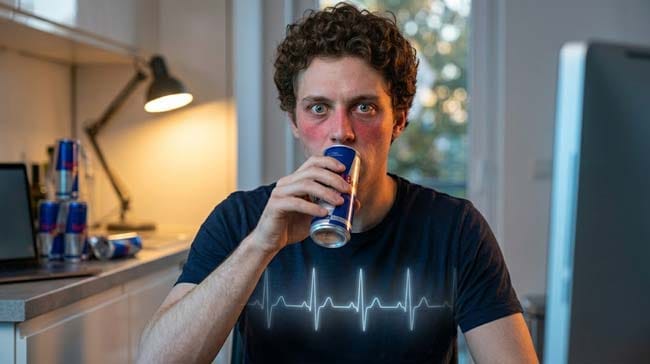
FAQ: Red Bull Effects on Heart and Brain
Q1: Can Red Bull cause a heart attack? For healthy adults with no pre-existing cardiovascular conditions, moderate Red Bull consumption is not associated with significant heart attack risk. However, documented cases exist of serious cardiac events — including myocardial infarction and sudden cardiac death — in individuals who consumed very large quantities (multiple cans in short periods) or who had undiagnosed cardiac conditions. People with known heart conditions, arrhythmias, hypertension, or family history of sudden cardiac death should consult their physician before consuming energy drinks.
Q2: Why do some people feel their heart racing after one Red Bull? Individual sensitivity to caffeine’s cardiac effects varies dramatically — determined primarily by genetic variants in the CYP1A2 enzyme (which metabolizes caffeine) and adenosine receptor genes. People who are “slow metabolizers” of caffeine experience more intense and prolonged cardiac effects from the same dose. Additionally, people who rarely consume caffeine have not developed receptor tolerance — meaning their cardiac response to a given dose is more pronounced than regular caffeine consumers.
Q3: Is Red Bull safe for teenagers? Health authorities including the American Academy of Pediatrics recommend against energy drink consumption by children and adolescents. The developing brain is more sensitive to caffeine’s effects on adenosine signaling — which plays important roles in normal brain development. Additionally, the cardiac effects of caffeine are potentially more pronounced in developing cardiovascular systems, and the combination with high sugar content raises additional metabolic concerns.
Q4: Does taurine in Red Bull actually do anything beneficial? Taurine has documented roles in cardiac function — particularly in regulating calcium handling in cardiac muscle cells. At the 1,000mg dose in Red Bull, taurine may genuinely modulate caffeine’s more extreme excitatory effects and contribute to a smoother stimulation profile. Some research also suggests taurine has antioxidant and cytoprotective effects on cardiac tissue. However, whether these effects are clinically significant at Red Bull consumption levels in healthy adults remains an active research area.
Q5: How long do Red Bull’s effects on the heart last? Caffeine’s half-life is approximately 5–6 hours in healthy adults — meaning 5–6 hours after consumption, approximately half the caffeine remains active. Full elimination typically takes 10–12 hours. Heart rate and blood pressure elevation typically normalize within 3–5 hours of a single can. Individuals who are slow caffeine metabolizers (CYP1A2 variants) may experience cardiac effects for 8–10 hours from a single can.
Conclusion: The Most Studied Energy Drink in the World
Red Bull is one of the most comprehensively studied consumer beverages in clinical literature — precisely because its cardiac and neurological effects are measurable, reproducible, and clinically significant at high doses.
In 3D, rendering the adenosine receptor blockade cascade — watching caffeine molecules occupy receptor sites while adenosine accumulates behind them, then watching the crash as caffeine clears and adenosine floods in — makes the pharmacology of energy drinks visually intuitive in a way that text cannot achieve.
Red Bull works because its mechanisms are real. The energy is real. The alertness is real. The cardiac acceleration is real. And the crash, the dependence, and the long-term cardiovascular implications at excessive doses are equally real.
Understanding the mechanism is the most effective form of informed consumption.
Further Study & External Research
3D Simulation Specs & Observations
| 3D Component | Technical Visual Setting | Observation from Viewport |
|---|---|---|
| Framerate | 120 FPS High-Speed | Captured ion channel dynamics and cardiac action potential visualization |
| Material/Shader | Subsurface Scattering (SSS) | Simulating cardiac muscle tissue and neural synapse translucency |
| Physics Engine | Volumetric Particle System + Electrostatic Simulation | Visualized ion flow, calcium sparks, neurotransmitter release |
| Goal | Educational / Science Visualization | Research-referenced 3D breakdown of Red Bull cardiac and neurological effects |
Read more on What Happens If You Only Drink Red Bull?
Pingback: What Happens If You Only Drink Red Bull? 3D Body Breakdown