
The Creator’s Note & Disclaimer: As a 3D artist at WhatIfBody3D, I rendered this scenario at 120 FPS. Our models explore what happens if you never clean your belly button — visualizing dead skin cell accumulation, bacterial colony growth, sebum buildup, and the formation of omphaloliths (belly button stones). This visualization is part of our “What If” series and is for educational and informational purposes only, as stated in our About Page.
Quick Answer: What Happens If You Never Clean Your Belly Button? (The Atomic Answer)
What happens if you never clean your belly button? The answer involves dead skin, sebum, sweat, lint, and over 2,000 species of bacteria — and in extreme cases, a hardened stone that can grow inside you for decades.
- The Accumulation: The belly button is a uniquely sheltered anatomical pocket — warm, moist, and largely protected from the self-cleaning mechanisms that maintain the rest of your skin. Dead skin cells, sebum, sweat, clothing fibers, and environmental debris accumulate continuously.
- The Bacteria: Studies have identified over 2,000 bacterial species in human belly buttons — with the average navel hosting approximately 67 distinct species at any given time. Without cleaning, this microbial community grows unchecked.
- The Stone: In the most extreme cases of neglect, accumulated material hardens over years into an omphalolith — a belly button stone that can reach the size of a marble or larger, requiring medical removal.
- The Smell: The combination of bacterial metabolism, sebum oxidation, and trapped moisture produces the characteristic unpleasant odor associated with uncleaned belly buttons — a product of bacterial volatile organic compounds released as metabolic byproducts.

My 3D Discovery: Rendering the “Hidden Ecosystem”
When I was setting up the belly button microbiome model for this simulation, the most visually striking realization was just how geologically layered the accumulation becomes over time. In the 3D viewport, the belly button cross-section resembles a geological core sample — distinct layers of material deposited over months and years, each layer representing a different period of accumulation.
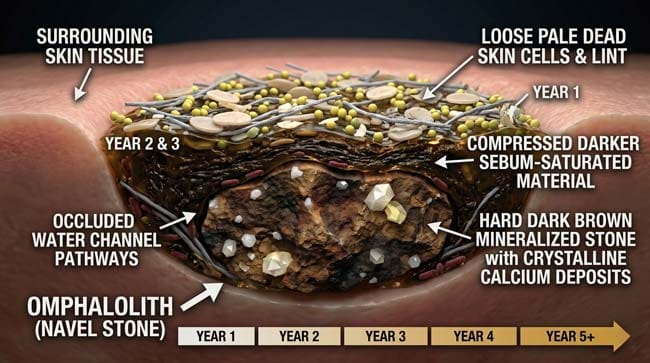
The outermost layer is recent — loose dead skin cells and lint. Beneath it, older material compressed by weight and moisture. Deeper still, sebum-saturated debris that has begun mineralizing. At the very bottom, in long-term neglect cases, the hardened calcified core of an omphalolith.
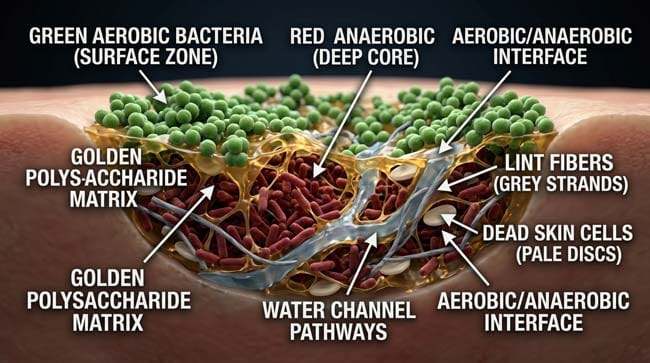
3D Observation: The most visually striking moment in this simulation is watching the bacterial colony time-lapse. I ran the colony growth simulation at 1,000x speed — showing what happens in an uncleaned belly button over weeks. What begins as a sparse population of individual bacterial cells becomes, within days of simulation time, a complex three-dimensional biofilm — bacteria embedded in a self-produced matrix of polysaccharides and proteins, creating a structured community with distinct regions of activity and dormancy. The biofilm looks less like a simple bacterial colony and more like a microscopic city.
Stage 1: What Accumulates — The Four-Layer System
The belly button collects material from four distinct sources simultaneously. In our 3D accumulation model, I rendered each source as a different colored particle type — showing how they combine and interact over time.
Layer 1 — Dead Skin Cells (Corneocytes)
The human body sheds approximately 30,000–40,000 dead skin cells per hour. The belly button — a recessed pocket with limited airflow and no friction from clothing contact at its deepest point — traps these cells instead of allowing them to fall away naturally.
In the 3D model, dead corneocytes appear as flat, disc-shaped particles — pale and translucent. They accumulate in the belly button’s folds and recesses, forming a continuous substrate layer on which other materials accumulate.
Layer 2 — Sebum
Sebaceous glands surrounding the navel produce sebum — a complex lipid mixture that normally lubricates and protects skin. In the belly button’s enclosed environment, sebum accumulates rather than spreading and evaporating. In the animation, sebum appears as amber-colored viscous droplets coating the dead skin layer — trapping further debris and providing a nutrient-rich substrate for bacterial growth.
Layer 3 — Sweat and Moisture
The belly button is positioned in an area of the body that generates significant sweat — particularly during physical activity. The recessed anatomy traps moisture rather than allowing evaporation. In the simulation, moisture shown as blue particles permeates the accumulated material — maintaining the warm, humid environment that bacteria require to thrive.
Layer 4 — Lint and Environmental Debris
Clothing fibers — particularly from cotton and synthetic fabrics — are continuously deposited in the belly button through normal body movement. Environmental particles (dust, pollen, pollutants) also accumulate. In the 3D model, lint appears as irregular fibrous strands that weave through the other accumulated materials — creating a structural matrix that traps and holds everything else in place.
| Accumulation Type | Source | 3D Color | Role in Buildup |
|---|---|---|---|
| Dead skin cells | Continuous skin shedding | Pale translucent discs | Primary substrate layer |
| Sebum | Sebaceous glands | Amber viscous droplets | Binds material, feeds bacteria |
| Sweat/moisture | Sweat glands | Blue particles | Maintains humid environment |
| Lint/debris | Clothing and environment | Grey fibrous strands | Structural matrix |
| Bacteria | Skin microbiome | Green/red colonies | Metabolizes all of the above |
According to the National Institutes of Health (NIH), the belly button’s unique anatomical structure — a warm, moist, recessed pocket with limited airflow — creates conditions that are significantly more hospitable to microbial growth than the surrounding abdominal skin surface. NIH: Human Skin Microbiome
Stage 2: The Bacterial Ecosystem — 2,000 Species in One Pocket
The belly button microbiome is one of the most studied and most surprising microbial ecosystems on the human body. The Belly Button Biodiversity Project — a citizen science study conducted by North Carolina State University — analyzed belly button swabs from 60 volunteers and identified over 2,368 bacterial species — of which 1,458 were previously unknown to science.
Why the Belly Button Has Such Extraordinary Bacterial Diversity:
In our 3D microbiome model, I rendered the belly button ecosystem as a microscopic landscape — different bacterial species occupying different ecological niches within the same small space.
The Anaerobic Core The deepest recesses of the belly button have very low oxygen levels — creating an anaerobic environment. In the 3D model, this zone appears as a dark, oxygen-depleted region populated by anaerobic bacteria — species that thrive in the absence of oxygen and produce the sulfur-containing volatile compounds responsible for the characteristic belly button odor.
The Aerobic Surface The outer portions of the belly button have more oxygen exposure — shown in the simulation as a brighter, more active zone populated by aerobic bacteria like Staphylococcus and Corynebacterium — the same species found throughout the skin surface microbiome.
The Biofilm Architecture Over time without cleaning, bacteria organize into a biofilm — a structured community embedded in a self-produced extracellular matrix. In the 3D animation, the biofilm appears as a complex three-dimensional structure — bacteria shown as individual spheres and rods embedded in a golden polysaccharide matrix, with water channels running through the biofilm to distribute nutrients.
Biofilms are significantly more resistant to removal and antimicrobial agents than individual planktonic bacteria — which is why thoroughly embedded belly button accumulation is harder to clean than fresh deposits.
The Odor Production Mechanism:
In our molecular simulation, I tracked the specific metabolic pathways that produce belly button odor:
- Anaerobic bacteria break down sebum fatty acids → producing butyric acid and propionic acid (sour, rancid smell)
- Staphylococcal species metabolize sweat components → producing isovaleric acid (cheesy smell)
- Corynebacterium species break down skin proteins → producing ammonia and sulfur compounds (pungent smell)
| Bacteria Type | Location in Belly Button | Metabolic Product | Odor Contribution |
|---|---|---|---|
| Anaerobes | Deep, oxygen-depleted core | Butyric acid, propionic acid | Sour, rancid notes |
| Staphylococci | Surface layers | Isovaleric acid | Cheesy notes |
| Corynebacteria | Surface and mid-layers | Ammonia, sulfur compounds | Pungent notes |
| Propionibacterium | Sebum-rich zones | Propionic acid | Sharp acidic notes |
According to research published in the Journal of the American Academy of Dermatology, the belly button microbiome is significantly more diverse than surrounding skin sites — with geographic and lifestyle factors producing dramatically different bacterial communities between individuals, explaining why belly button odor profiles vary considerably from person to person. JAAD: Skin Microbiome Diversity
Stage 3: The Omphalolith — When Neglect Creates a Stone
In the most extreme cases of belly button neglect — typically developing over years to decades — the accumulated material undergoes a process of progressive compression and partial mineralization, eventually forming a hardened mass called an omphalolith (from the Greek: omphalos = navel, lithos = stone).
How an Omphalolith Forms:
In our 3D geological model, I rendered omphalolith formation as a time-lapse process:
Year 1–2: Initial Accumulation Dead skin, sebum, lint, and bacteria accumulate in loose layers. The material is soft and easily removed with normal cleaning. In the simulation, this phase shows a loose, heterogeneous mass of different-colored particles — not yet compressed or consolidated.
Year 3–5: Compression and Consolidation The weight of upper layers compresses lower layers. Sebum begins oxidizing and polymerizing — becoming increasingly solid. Bacterial activity partially mineralizes organic material. In the animation, the lower layers begin darkening and densifying — the particle boundaries becoming less distinct as materials merge.
Year 5+: Mineralization Calcium salts from sweat and sebum begin crystallizing within the compressed mass. The core becomes progressively harder — dark brown to black in color from oxidized sebum and melanin deposits. In the 3D model, the core shown as a dense dark sphere surrounded by less consolidated peripheral material.
Clinical Characteristics of Omphaloliths:
| Characteristic | Description | 3D Visualization |
|---|---|---|
| Color | Dark brown to black | Oxidized sebum and melanin deposits |
| Texture | Hard, stone-like outer shell | Mineralized calcium salts |
| Size | 0.5cm to 3cm+ | Grows slowly over years |
| Composition | Sebum, dead skin, keratin, bacteria, calcium | Layered geological cross-section |
| Formation time | Years to decades | Time-lapse geological model |
| Removal | Medical extraction — often requires softening agents | Endoscopic or manual removal visualization |
Medical Case Documentation: Omphaloliths are rare but documented in medical literature. Case reports describe stones removed from patients who had experienced progressive navel inflammation, pain, and discharge — not realizing the accumulation was occurring. The largest documented cases involved stones several centimeters in diameter, requiring surgical removal under local anesthesia.
According to the American Journal of Clinical Dermatology, omphaloliths most commonly occur in individuals with deep, narrow navel anatomy (particularly innie belly buttons with tight, narrow openings), obesity (which creates deeper skin folds), and limited mobility that prevents adequate self-cleaning. AJCD: Omphalolith — Clinical Review

FAQ: What Happens If You Never Clean Your Belly Button?
Q1: How often should you actually clean your belly button? For most people, cleaning the belly button once per week during normal showering is sufficient to prevent significant accumulation. The cleaning method matters — using a cotton swab moistened with mild soap or diluted hydrogen peroxide to gently clean the folds is effective. Avoid aggressive scrubbing which can irritate the delicate skin inside the navel. After cleaning, ensure the area is dried thoroughly — moisture remaining in the belly button creates the humid environment that accelerates bacterial growth.
Q2: Is belly button bacteria dangerous? For healthy individuals with intact immune systems, the belly button’s bacterial community is generally not dangerous — it is simply part of the normal skin microbiome. However, if the skin inside the belly button is broken — through scratching, piercing, or excessive moisture causing skin breakdown — the bacterial community can cause localized infection (omphalitis). Signs of belly button infection include redness, swelling, discharge, and pain — which warrant medical evaluation.
Q3: Why does everyone’s belly button smell different? Belly button odor profiles are determined by the specific bacterial communities present — which vary dramatically between individuals based on genetics, diet, hygiene habits, body hair density, navel anatomy, and geographic location. The North Carolina State study found that some people had a single dominant bacterial species while others had dozens — explaining why belly button odor ranges from barely noticeable to significantly unpleasant between different individuals.
Q4: Can belly button piercings affect bacterial accumulation? Yes — significantly. Belly button piercings disrupt the normal skin barrier, create additional surface area for bacterial attachment, and introduce metal objects that can harbor biofilm formation. Piercings also make thorough cleaning more challenging. Infected belly button piercings are one of the most common complications of body piercing — combining the navel’s naturally high bacterial density with a compromised skin barrier and foreign material.
Q5: Is it possible to completely sterilize your belly button? No — and it would not be desirable even if possible. The belly button microbiome, like all skin microbiome communities, serves protective functions — the resident bacterial community occupies ecological niches that prevent colonization by more harmful organisms (competitive exclusion). Complete sterilization would leave the navel vulnerable to opportunistic infection by pathogens. The goal of cleaning is to control accumulation and prevent overgrowth — not to eliminate all bacteria.
Conclusion: The Most Overlooked Real Estate on Your Body
The belly button is a uniquely neglected anatomical space — present from birth, rarely seen, and forgotten in most hygiene routines. Yet it hosts one of the most diverse microbial ecosystems on the human body, accumulates material from four continuous sources, and in extreme cases produces a mineralized geological artifact of personal hygiene history.
In 3D, rendering the belly button cross-section as a geological core sample — complete with distinct accumulation layers, a thriving bacterial biofilm, and a hardening omphalolith core — transforms what is usually an object of mild embarrassment into a genuinely fascinating demonstration of what happens when a warm, moist, sheltered space is left to its own biological devices.
Clean your belly button. Once a week. It takes thirty seconds.
Further Study & External Research
3D Simulation Specs & Observations
| 3D Component | Technical Visual Setting | Observation from Viewport |
|---|---|---|
| Framerate | 120 FPS High-Speed | Captured bacterial colony growth dynamics and omphalolith formation time-lapse |
| Material/Shader | Subsurface Scattering (SSS) | Simulating skin tissue translucency, sebum viscosity, and stone mineralization |
| Physics Engine | Volumetric Particle System + Rigid Body | Visualized bacterial biofilm architecture and geological layer compression |
| Goal | Educational / Science Visualization | Research-referenced 3D breakdown of belly button accumulation and microbial ecosystem |
Continue read more on Belly Button Bacteria
Pingback: Belly Button Bacteria: The 3D Microbiome Science Guide