
The Creator’s Note & Disclaimer: As a 3D artist at WhatIfBody3D, I rendered this scenario at 120 FPS. Our models explore whether swallowed gum stays in your stomach for 7 years — visualizing the complete myth-busting science of gum base transit, peristaltic mechanics, and the real digestive timeline. This visualization is part of our “What If” series and is for educational and informational purposes only, as stated in our About Page.
Quick Answer: Does Swallowed Gum Stay in Your Stomach for 7 Years? (The Atomic Answer)
Does swallowed gum stay in stomach for 7 years? The answer is a definitive, scientifically proven no. No. Definitively, scientifically, completely no.
- The Real Number: Swallowed gum base passes through your digestive system and is expelled in stool within 40 hours to 7 days — not 7 years, not 7 months, not even 7 weeks.
- The Myth Origin: The 7-year claim has no traceable origin in medical or scientific literature. It appears to be a parental deterrent that became cultural folklore — repeated so often it acquired the status of fact.
- The Science: Gum base is indigestible — meaning your digestive enzymes cannot break it down. But indigestible does not mean immovable. Your digestive system’s mechanical transport system — peristalsis — moves indigestible material through just as efficiently as digestible food.
- The Comparison: Corn kernels, grape seeds, and certain plant fibers are also largely indigestible — and nobody claims they stay in your stomach for 7 years. Gum base behaves identically.

My 3D Discovery: Building the “7-Year Myth Simulator”
When I was designing this simulation, I decided to actually model what it would take for gum to stay in the stomach for 7 years — to show why it is physically impossible under normal digestive conditions.
In the 3D viewport, I ran two simultaneous simulations side by side. On the left: what the myth claims — a piece of gum sitting stationary in the stomach for years, accumulating more gum, growing into a mass. On the right: what actually happens — the gum being churned, processed, and systematically moved through the digestive system by peristalsis within days.
3D Observation: The most revealing moment in this simulation is showing what would need to be true for the 7-year myth to be real. The stomach would need to have no peristaltic contractions. The pyloric sphincter would need to be permanently sealed against indigestible material. And the entire 30-foot digestive transport system would need to selectively stop for gum while continuing normally for everything else. None of these things are true. Peristalsis does not check whether a substance is digestible before moving it. It moves everything forward — digestible or not.
Stage 1: The Origin of the 7-Year Myth — Where Did It Come From?
The 7-year gum myth is one of the most durable pieces of nutritional folklore in modern culture — believed by millions of people across multiple generations. Understanding why it persisted requires understanding both what is partially true about it and what the cultural mechanisms of myth propagation look like.
What is partially true: Gum base IS indigestible. Your stomach’s enzymes genuinely cannot break it down. This kernel of truth — “your body can’t digest gum” — is scientifically accurate. The leap from “cannot be digested” to “stays for 7 years” is where the myth diverges completely from reality.
The cultural mechanism: In the 3D model, I visualized the myth propagation pathway — not biological, but informational:
- Parent tells child “don’t swallow gum, it stays in your stomach for 7 years”
- Child has no counter-information and accepts the claim
- Child grows up and repeats the claim to their own children
- The specificity of “7 years” (rather than “a long time”) gives the claim false precision that makes it sound more factual
Why 7 years specifically? No definitive origin has been established. Medical historians have traced versions of the claim to at least the mid-20th century in the United States. The number 7 appears in many folk beliefs about body regeneration (the idea that the body completely replaces all its cells every 7 years — also a myth) — suggesting the number may have cross-contaminated from other folk beliefs.
What medical literature actually says: A search of medical literature reveals no peer-reviewed studies supporting a 7-year gastric retention time for gum base. The studies that exist on gum base transit confirm it follows normal indigestible material transit patterns.
| Claim | Scientific Status | Evidence |
|---|---|---|
| “Gum base is indigestible” | ✅ TRUE | Enzyme resistance confirmed in chemistry research |
| “Gum stays in stomach for 7 years” | ❌ FALSE | No medical literature support |
| “Gum passes through in days” | ✅ TRUE | Consistent with indigestible material transit studies |
| “Swallowing occasional gum is harmless” | ✅ TRUE | No documented harm in healthy adults from single pieces |
According to the National Institutes of Health (NIH), the normal gastrointestinal transit time for indigestible solids — materials that cannot be broken down by digestive enzymes — ranges from 40 hours to approximately 7 days in healthy adults, depending on individual gut motility, diet, and hydration status. NIH: Gastrointestinal Transit Time
Stage 2: The Real Science — What Peristalsis Actually Does
The core reason the 7-year myth is impossible is peristalsis — the muscular transport system of your digestive tract. Understanding peristalsis makes it immediately obvious why no indigestible material, including gum, can remain stationary in the digestive system for years under normal conditions.
What is peristalsis?
Peristalsis is the coordinated, rhythmic contraction of smooth muscle layers in the walls of the esophagus, stomach, small intestine, and large intestine. In our 3D animation, I rendered it as continuous wave-like contractions traveling in one direction — always toward the exit.
Key properties of peristalsis that destroy the 7-year myth:
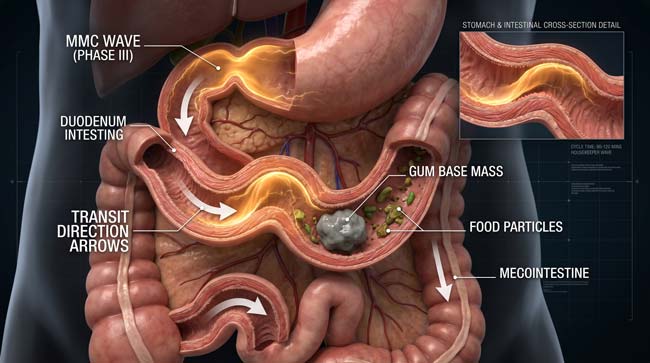
1. It is continuous and involuntary Peristalsis does not stop during sleep, during fasting, or during illness. The migrating motor complex — shown in the simulation as a sweeping wave of contractions that occurs every 90–120 minutes during fasting — specifically functions to clear indigestible debris from the stomach and small intestine between meals. This is called the “intestinal housekeeper.”
2. It does not discriminate by digestibility Peristalsis moves material based on its physical presence — not its chemical properties. A piece of gum and a piece of perfectly nutritious food are treated identically by peristaltic mechanics. Both are moved forward.
3. The stomach has a specific clearance mechanism for indigestible solids During the fasting state, the stomach’s migrating motor complex generates high-amplitude contractions specifically designed to empty indigestible residue into the small intestine. This is why the stomach does not accumulate indigestible material over time.
The Migrating Motor Complex — The Intestinal Housekeeper:
In our 3D simulation, I dedicated an entire sequence to the Migrating Motor Complex (MMC) — the digestive system’s built-in cleaning cycle. During fasting periods (between meals), the MMC generates a sweeping wave of contractions every 90–120 minutes that travels from the stomach through the entire small intestine.
In the animation, this appears as a powerful wave of muscular contraction that physically sweeps the intestinal contents forward — including any indigestible gum base sitting in the stomach. The MMC is specifically responsible for preventing the accumulation of indigestible material in the stomach.
| Digestive Mechanism | Frequency | Effect on Gum Base | 3D Visual |
|---|---|---|---|
| Gastric peristalsis | 3 contractions/minute | Churns and repositions gum | Wave compressions on stomach wall |
| Migrating Motor Complex | Every 90–120 min (fasting) | Sweeps gum toward pylorus | Powerful sweeping wave animation |
| Pyloric contractions | Variable | Eventually passes gum into small intestine | Sphincter opening and closing |
| Small intestine peristalsis | Continuous | Moves gum toward large intestine | Sequential wave contractions |
| Large intestine mass movements | 1–3 times/day | Propels gum toward rectum | Large-amplitude propulsive contractions |
Stage 3: The Actual Transit Timeline — Gum vs. Other Indigestibles
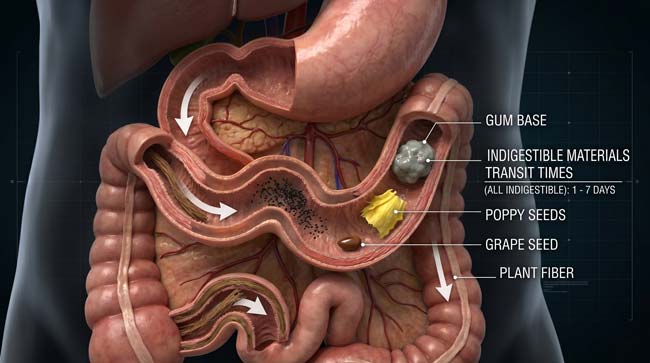
One of the most effective ways to demonstrate that the 7-year myth is false is to compare gum base transit to other indigestible materials that nobody claims stay in the stomach for 7 years.
The Indigestible Material Comparison:
Corn kernels The outer hull of corn kernels (pericarp) is made of cellulose — completely indigestible by human enzymes. Yet corn kernels pass through and appear in stool within 1–3 days. Nobody claims corn stays in the stomach for 7 years.
Grape seeds Grape seeds contain indigestible seed coats that resist digestive enzyme breakdown. Transit time: 1–4 days.
Poppy seeds Tiny but indigestible — documented in forensic and medical literature as appearing in urine drug tests within 4–6 hours of consumption and in stool within 1–3 days.
Certain plant fibers Lignin and some forms of cellulose are completely indigestible. Transit time: follows normal 40-hour to 7-day range.
Gum base Indigestible polymer — transit time: 40 hours to 7 days.
In our 3D comparison model, I showed all five materials simultaneously traveling through a transparent digestive system — each one moving at similar speeds, each one arriving at the exit within a similar timeframe.
| Indigestible Material | Digestibility | Transit Time | “Stays for 7 Years” Myth? |
|---|---|---|---|
| Corn kernel hull | 0% | 1–3 days | No |
| Grape seeds | ~0% | 1–4 days | No |
| Poppy seeds | ~0% | 1–3 days | No |
| Plant fiber (lignin) | 0% | 1–7 days | No |
| Gum base | 0% | 1–7 days | Yes — myth only |
The comparison makes the myth’s logical inconsistency visually obvious. If indigestibility caused 7-year retention, every indigestible material would stay for 7 years. None of them do.
According to the American Gastroenterological Association, gastrointestinal transit of indigestible solids follows predictable patterns governed by gut motility — with no mechanism by which any specific indigestible material would be selectively retained for years in a healthy digestive system. AGA: Gastrointestinal Motility

FAQ: Does Swallowed Gum Stay in Your Stomach for 7 Years?
Q1: If gum doesn’t stay for 7 years, why did my parents tell me it does? The 7-year myth is one of the most successful parental deterrents in modern culture — told to children to discourage swallowing gum, which is genuinely unnecessary. It works as a deterrent precisely because it is specific and memorable. The problem is that it is completely false, and children who grow up believing it sometimes develop unnecessary anxiety about accidentally swallowing gum or spread the myth to their own children.
Q2: Has anyone ever actually had gum stay in their stomach for years? Extremely rare case reports exist of bezoars (accumulated masses of indigestible material) forming in children who swallowed very large quantities of gum regularly over extended periods — sometimes combined with swallowing other objects. These cases involve extraordinary quantities, not single or occasional pieces. No documented case exists of a single piece of gum remaining in a stomach for anywhere near 7 years.
Q3: Is it safe to swallow gum? For healthy adults and older children, occasionally swallowing a piece of gum is medically harmless. The gum base will pass through normally within days. The only situations where gum swallowing warrants concern are young children swallowing multiple pieces repeatedly, or people with pre-existing gastrointestinal conditions that slow gut motility.
Q4: Does swallowing gum affect gut bacteria? Current research suggests gum base has minimal interaction with gut microbiome. Some synthetic polymers in gum base may have very minor antimicrobial effects, but the contact time during transit is too brief for significant microbiome disruption. The sweeteners and emulsifiers in gum — which are digested normally — have more potential for gut microbiome interaction than the gum base itself.
Q5: What is the strangest thing that actually can stay in the stomach for years? Certain types of trichobezoars — hairballs formed from swallowed hair — can accumulate in the stomach over years if the behavior continues. This condition, associated with trichotillomania (compulsive hair-pulling and swallowing), has produced documented cases of hairballs weighing several kilograms removed surgically from patients. Hair — not gum — is the substance with genuine long-term gastric accumulation potential.
Conclusion: The Myth That Survived Because It Worked
The 7-year gum myth is a case study in how false health claims persist — not because they are plausible to scientists, but because they are useful to parents and memorable to children. A claim does not need to be true to be effective as a behavioral deterrent.
In 3D, showing peristalsis moving gum base through the digestive system at the same speed as corn kernels and grape seeds makes the biological reality immediately clear. The digestive system does not read ingredient labels. It does not treat indigestible materials with special caution or long-term storage. It moves everything forward — digestible or not — with the same relentless mechanical efficiency.
The gum you swallowed as a child did not spend 7 years in your stomach. It spent a few days taking the same journey as everything else you ever ate — and then it left.
Further Study & External Research
3D Simulation Specs & Observations
| 3D Component | Technical Visual Setting | Observation from Viewport |
|---|---|---|
| Framerate | 120 FPS High-Speed | Captured peristaltic wave mechanics and Migrating Motor Complex visualization |
| Material/Shader | Subsurface Scattering (SSS) | Simulating digestive tract tissue translucency and gum base polymer surface |
| Physics Engine | Soft Body Dynamics + Fluid Simulation | Visualized peristaltic contractions, gum base deformation, and transit comparison |
| Goal | Educational / Science Visualization | Research-referenced 3D myth-busting breakdown of swallowed gum transit science |
Read more on What Happens If You Swallow Gum?
Pingback: What Happens If You Swallow Gum? The 3D Digestive Truth