
The Creator’s Note & Disclaimer: As a 3D artist at WhatIfBody3D, I rendered this scenario at 120 FPS. Our models explore what happens if you swallow gum — visualizing gum base resistance to digestive enzymes, peristaltic transport mechanics, and the complete journey through the gastrointestinal tract. This visualization is part of our “What If” series and is for educational and informational purposes only, as stated in our About Page.
Quick Answer: What Happens If You Swallow Gum? (The Atomic Answer)
You swallowed a piece of gum. Every adult has done it at least once. Here is what actually happens — and why almost everything you were told as a child was wrong.
- The Truth: Swallowed gum does NOT stay in your stomach for 7 years. It does NOT accumulate into a rubbery mass. It does NOT block your digestive system under normal circumstances.
- The Real Journey: Gum base — the indigestible rubber-like component of chewing gum — passes through your digestive system largely intact and is expelled within 40 hours to 7 days, following the same timeline as other indigestible materials.
- The Exception: While a single piece of gum is harmless, swallowing very large quantities of gum in a short period — particularly in young children — can theoretically cause a bezoar (a compacted mass of indigestible material) that may require medical removal.
- The Science: Your digestive system is extraordinarily effective at moving indigestible material through — even when it cannot break it down. The gum base simply becomes a passenger on the normal digestive transit route.

My 3D Discovery: Rendering the “Indestructible Passenger”
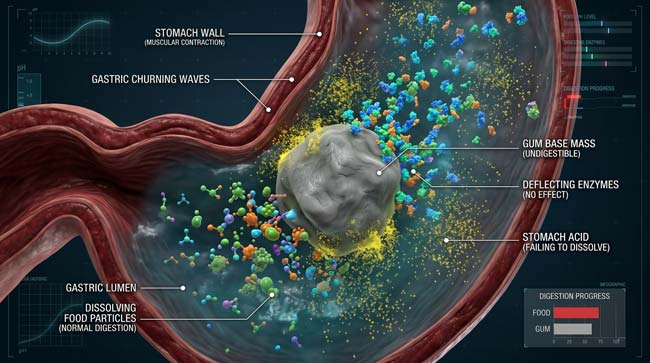
When I was building the gum base molecular model for this simulation, the most visually striking sequence was watching the digestive enzyme attack — and fail. In a normal digestion scene, food particles dissolve progressively as enzymes make contact. The gum base model simply sits there, enzyme particles bouncing off its surface with no effect.
In the 3D viewport, I rendered the gum base as a dense grey-white mass with a molecular surface structure that enzyme particles cannot penetrate. Amylase, pepsin, lipase — each shown as different colored particles — approach the gum base and deflect. The gum does not dissolve. It does not shrink. It simply waits.
3D Observation: The most interesting moment in this simulation is watching the stomach’s mechanical churning attempt to break down the gum base. Gastric contractions — shown as rhythmic waves of pressure across the stomach wall — compress and manipulate the gum, but cannot fragment it. Eventually, the pyloric sphincter opens, and the gum base passes into the small intestine — not as a digested nutrient, but as an intact foreign object being physically transported by peristalsis.
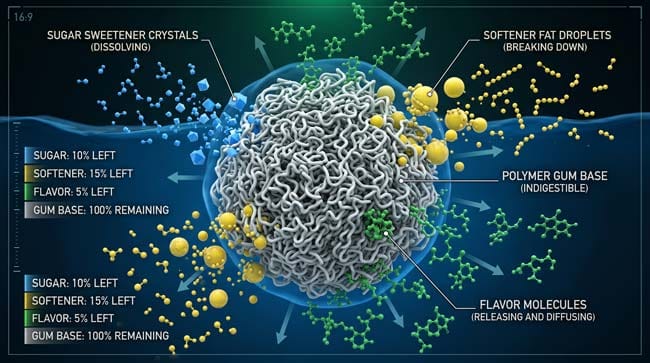
Stage 1: What Gum Is Actually Made Of — The Chemistry of Indigestion
Understanding what happens when you swallow gum requires understanding what gum actually is — because its composition is what makes it behave so differently from every other food you eat.
Modern chewing gum has four primary components:
1. Gum Base (20–30% of gum weight) The indigestible component. Modern gum base is a complex mixture of:
- Elastomers — synthetic rubbers (polyisobutylene, polyvinyl acetate) or natural rubber (chicle from the Sapodilla tree)
- Resins — polyvinyl acetate and ester gum provide texture
- Waxes — paraffin or beeswax for softness
- Emulsifiers — lecithin for consistency
- Fillers — calcium carbonate or talc for bulk
In our 3D molecular model, the gum base appears as an interlocking polymer network — long chain molecules bonded in a structure that digestive enzymes cannot access or cleave.
2. Sweeteners (60–70%) Sugar or sugar alcohols (sorbitol, xylitol, mannitol). These are entirely digestible — broken down and absorbed in the small intestine exactly like any other carbohydrate.
3. Softeners (5–10%) Glycerol or vegetable oil derivatives. Also fully digestible and absorbed normally.
4. Flavoring agents (<1%) Natural or artificial flavors. Fully digestible.
The critical insight: When you swallow gum, approximately 70–80% of it is digested and absorbed completely normally. Only the gum base — 20–30% of the total — remains intact and must be physically transported out.
| Gum Component | Digestible? | What Happens to It | 3D Visualization |
|---|---|---|---|
| Sweeteners | ✅ Yes | Absorbed in small intestine | Dissolving sugar particles |
| Softeners | ✅ Yes | Digested like normal fats | Lipase breakdown |
| Flavoring | ✅ Yes | Absorbed normally | Rapid dissolution |
| Gum base | ❌ No | Transported intact through GI tract | Grey-white mass moving unchanged |
According to the American Chemical Society, gum base polymers — particularly polyisobutylene — have molecular structures that are completely resistant to human digestive enzymes because they lack the chemical bonds (peptide bonds, ester bonds, glycosidic bonds) that digestive enzymes are designed to cleave. ACS: Chemistry of Chewing Gum
Stage 2: The Complete Digestive Journey — Hour by Hour
In our complete simulation, I tracked a single piece of swallowed gum through every stage of the digestive system, measuring the response of each organ and the gum base behavior at each location.
The Mouth and Esophagus (0–10 seconds)
The moment gum is swallowed, the swallowing reflex (deglutition) is triggered. The epiglottis closes over the airway — shown in the 3D model as a protective flap sealing the trachea. The gum bolus is propelled down the esophagus by peristaltic contractions in approximately 8–10 seconds.
The gum arrives at the lower esophageal sphincter — a muscular valve that prevents stomach acid reflux. The sphincter relaxes and the gum enters the stomach.
The Stomach (10 minutes to 4 hours)
This is where the most dramatic digestive failure occurs — and where the 7-year myth originates.
The stomach deploys its full digestive arsenal:
- Hydrochloric acid (pH 1.5–3.5) — attacks the gum base surface. Result: no significant degradation.
- Pepsin — protein-digesting enzyme. Result: gum base contains no digestible proteins. No effect.
- Mechanical churning — gastric contractions at 3 contractions per minute attempt to fragment the gum. Result: gum base deforms under pressure but does not fragment or dissolve.
In the 3D stomach model, this is the most visually dramatic sequence — the stomach’s churning shown as powerful muscular waves compressing the gum from all sides, while enzyme particles continuously deflect off the gum base surface.
The sweeteners, softeners, and flavoring dissolve rapidly and are absorbed through the stomach wall. The gum base — now stripped of everything digestible — sits as a small, dense, rubbery mass in the stomach.
The pyloric sphincter — the valve between the stomach and small intestine — normally only opens for liquid or very finely ground material. Large solid objects are retained in the stomach for further mechanical processing. The gum base is eventually passed through in small contractions, particularly when the stomach is otherwise empty.
The Small Intestine (4–24 hours)
The small intestine is 20 feet long and the primary site of nutrient absorption. For the gum base, it is simply a long tube to transit.
Digestive enzymes from the pancreas and liver (lipase, amylase, proteases, bile acids) make contact with the gum base. In our simulation, I showed each enzyme type as a different colored particle — each approaching the gum base surface and deflecting without effect.
The gum base is propelled forward by peristalsis — rhythmic muscular contractions shown in the animation as wave after wave pushing the gum base steadily forward through the intestinal tube.
The small intestine does successfully absorb the last remaining digestible gum components — residual sweeteners and emulsifiers that survived stomach processing.
The Large Intestine and Colon (24–72 hours)
The gum base enters the large intestine — now completely stripped of all digestible material. Water is absorbed from the surrounding material, but the gum base itself is unaffected.
Gut bacteria — shown as tiny green organisms in the 3D colon model — attempt to colonize and metabolize the gum base surface. Most synthetic polymer gum bases show minimal bacterial degradation. Natural rubber (chicle) bases may be slightly more susceptible to microbial action, but the timeframe of transit is too short for significant degradation.
The gum base is incorporated into the fecal mass and continues toward the rectum.
The Exit (40 hours to 7 days)
The gum base is expelled with normal bowel movements. Total transit time from swallowing to expulsion: 40 hours to 7 days — identical to other indigestible materials like certain plant fibers and seeds.
| Digestive Stage | Time | Gum Base Response | What Dissolves |
|---|---|---|---|
| Mouth | Seconds | Swallowed intact | Saliva softens surface slightly |
| Esophagus | 8–10 seconds | Transported by peristalsis | Nothing |
| Stomach | 10 min–4 hours | Acid and enzyme resistant — churned but intact | Sweeteners, softeners, flavoring |
| Small intestine | 4–24 hours | Peristalsis transport — enzyme resistant | Residual digestible components |
| Large intestine | 24–72 hours | Water absorption from surroundings — gum unchanged | Nothing |
| Expulsion | 40 hours–7 days | Expelled intact in stool | Complete exit |
According to the Mayo Clinic, while gum base is not digestible, it moves through the digestive system normally and is expelled in stool, typically within several days — consistent with the transit time of other indigestible materials. Mayo Clinic: Is It Harmful to Swallow Gum?

Stage 3: When It Can Actually Be a Problem
For the vast majority of people in the vast majority of situations, swallowing gum is medically insignificant. However, there are three specific scenarios where problems can arise.
Scenario 1 — Young Children Swallowing Multiple Pieces
The most clinically documented cases of gum-related digestive problems involve young children (typically under 5) who swallow multiple pieces of gum in a short period — sometimes compounded by swallowing other indigestible objects simultaneously.
In rare cases, this can form a bezoar — a compacted mass of indigestible material that accumulates faster than the digestive system can move it through. In the 3D model, a bezoar appears as a growing dense mass in the stomach or intestine, progressively accumulating until it becomes too large to pass through the pyloric sphincter.
Documented bezoar cases from gum: Case reports exist of children requiring endoscopic or surgical removal of large accumulated gum masses. These cases are extremely rare but document the theoretical risk of large-quantity gum swallowing.
Scenario 2 — Swallowing Gum With Seeds or Coins
Gum’s sticky surface can trap other objects swallowed simultaneously — creating a larger composite mass. In the simulation, this appears as the gum base accumulating surface attachments that increase its total diameter — potentially creating a mass too large for normal pyloric passage.
Scenario 3 — Pre-existing Digestive Conditions
People with gastroparesis (slow stomach emptying), Crohn’s disease, or intestinal strictures may have reduced ability to move indigestible material through the system. For these individuals, swallowed gum carries a higher risk of accumulation at narrowed sections of the GI tract.
| Risk Scenario | Who Is Affected | Risk Level | Medical Response |
|---|---|---|---|
| Single piece, healthy adult | Everyone | Negligible | None needed |
| Multiple pieces, young child | Children under 5 | Low-moderate | Monitor; seek care if GI symptoms |
| Large quantity, any age | Anyone | Moderate | Seek medical evaluation |
| Pre-existing GI conditions | Specific patients | Moderate-high | Consult physician |
FAQ: What Happens If You Swallow Gum?
Q1: Does swallowed gum really stay in your stomach for 7 years? No — this is entirely a myth with no scientific basis. The 7-year figure has no known origin in medical literature. Gum base passes through the digestive system and is expelled in stool within 40 hours to 7 days — the same transit time as other indigestible materials like certain seeds and plant fibers. The myth likely persisted because gum base is indigestible — but indigestible does not mean immovable.
Q2: Can you see the gum in your stool after swallowing it? Theoretically yes, though the gum base is typically incorporated into the fecal mass and not obviously visible. The original flavor, color, and sweeteners have been fully digested — what exits is the stripped polymer base, which may appear as a small grayish rubbery fragment if visible at all.
Q3: Is xylitol gum dangerous to swallow? For humans, swallowed xylitol (a sugar alcohol used in sugar-free gum) is metabolized normally at typical gum quantities. For dogs, xylitol is highly toxic — causing dangerous insulin release and potential liver failure even in small amounts. Never give dogs sugar-free gum or leave it accessible to pets.
Q4: What should I do if my young child swallows a lot of gum? For a single piece or small amount, no action is needed in a healthy child. If a young child has swallowed multiple pieces (more than 5–7) in a short period, or if they develop abdominal pain, vomiting, or constipation in the following days, consult a physician. Mention the gum swallowing specifically so the doctor can assess for potential bezoar formation.
Q5: Is it true that gum takes longer to digest than other foods? The gum base component does not “take longer to digest” — it is not digested at all, but transported. The digestible components of gum (sweeteners, softeners, flavoring) are digested at normal speed — actually faster than most foods because they are already in simple molecular forms. The gum base simply travels the normal intestinal route as an indigestible passenger.
Conclusion: The Most Harmless Indigestible Thing You Will Ever Swallow
Swallowing gum is, for the vast majority of people, completely medically insignificant. The gum base — the only component that survives digestion — is simply transported through your digestive system by the same peristaltic machinery that moves everything else, and expelled within days.
In 3D, watching digestive enzymes deflect harmlessly off the gum base surface — while every other component of the gum dissolves and absorbs normally around it — makes the mechanism visually clear. The gum base is not causing damage. It is not accumulating. It is simply waiting for the body’s transport system to carry it to the exit.
The 7-year myth has entertained parents and terrified children for generations. The scientific reality is considerably less dramatic — and considerably more reassuring.
Further Study & External Research
3D Simulation Specs & Observations
| 3D Component | Technical Visual Setting | Observation from Viewport |
|---|---|---|
| Framerate | 120 FPS High-Speed | Captured peristaltic transport mechanics and enzyme deflection dynamics |
| Material/Shader | Subsurface Scattering (SSS) | Simulating digestive tissue translucency and gum base polymer surface |
| Physics Engine | Soft Body Dynamics + Fluid Simulation | Visualized gum base deformation under gastric pressure, enzyme particle deflection |
| Goal | Educational / Science Visualization | Research-referenced 3D breakdown of swallowed gum digestive journey |
Read more on Does Swallowed Gum Stay in Your Stomach for 7 Years?
Pingback: Does Swallowed Gum Stay in Your Stomach for 7 Years? Busted