
The Creator’s Note & Disclaimer: As a 3D artist at WhatIfBody3D, I rendered this scenario at 120 FPS. Our models explore what happens if you eat a poisonous mushroom — visualizing toxin absorption, neurological hijacking, liver cell destruction, and the medical intervention timeline. This visualization is part of our “What If” series and is for educational and informational purposes only, as stated in our About Page.
Quick Answer: What Happens If You Eat a Poisonous Mushroom? (The Atomic Answer)
One bite of the wrong mushroom can trigger a cascade of events that unfolds across hours, days, and in severe cases — weeks. The outcome depends entirely on which species you consumed.
- The Most Dangerous: Amanita phalloides (Death Cap) is responsible for approximately 90% of mushroom-related fatalities worldwide. A single cap contains enough amatoxin to kill an adult human — and symptoms may not appear for 6–24 hours after ingestion, by which time organ damage is already occurring.
- The Neurological Hijacker: Amanita muscaria (Fly Agaric) contains Muscimol and Ibotenic Acid — compounds that directly mimic and block neurotransmitters, producing hallucinations, muscle twitching, and loss of body control within 30–90 minutes.
- The Deception: Many toxic mushrooms taste normal or even pleasant. Your body receives no immediate warning signal — no burning, no obvious alarm. The toxins absorb silently and begin their damage long before any symptom appears.
- The Timeline: Neurological mushroom toxins produce symptoms within 30 minutes to 2 hours. Liver-destroying amatoxins produce symptoms only after 6–24 hours — by which time significant hepatic damage has already occurred at the cellular level.

My 3D Discovery: Rendering the “Silent Invasion”
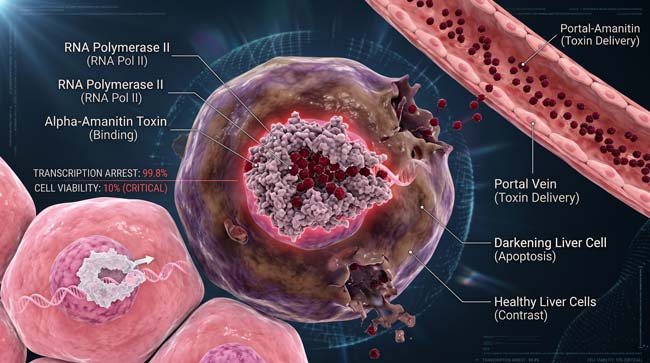
When I was building the toxin absorption model for this simulation, the most striking visual was how completely invisible the initial absorption process is. In the 3D viewport, Amatoxin molecules — rendered as dark red particles — cross the intestinal wall within minutes of ingestion. They enter the portal vein and travel directly to the liver. The liver cells attempt to process them normally. And that is when the destruction begins.
The toxins are not destroying the liver from outside — they are being actively pulled inside liver cells by the same transport proteins that normally import beneficial compounds. The liver is essentially destroying itself by trying to do its job.
3D Observation: The most visually dramatic sequence in this simulation is watching a healthy liver cell encounter Amatoxin for the first time. The cell’s RNA polymerase II enzyme — shown as a complex molecular machine that produces all of the cell’s proteins — physically seizes when Amatoxin binds to it. In the animation, it looks like a factory assembly line suddenly stopping mid-operation. Every protein the cell was producing halts simultaneously. The cell cannot repair itself. It cannot divide. It can only begin dying.
Stage 1: The Two Types of Poisonous Mushrooms — Two Completely Different Attacks
Not all toxic mushrooms attack the body the same way. In our simulation, I modeled two distinct toxin categories that represent the most common and most dangerous poisoning scenarios.
Category 1 — Neurotoxic Mushrooms (Fast Attack)
Species: Amanita muscaria (Fly Agaric), Psilocybe species, Inocybe species
Primary toxins: Muscimol, Ibotenic Acid, Muscarine
These toxins target the nervous system directly and produce effects within 30–90 minutes of ingestion.
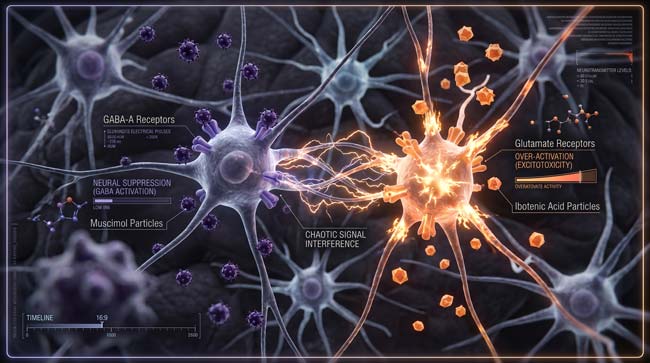
Muscimol — a GABA-A receptor agonist that mimics the brain’s primary inhibitory neurotransmitter. In our molecular model, Muscimol molecules bind to GABA-A receptors with higher affinity than natural GABA — shown as dark purple particles locking onto receptor sites and refusing to release. The result is excessive neural inhibition — the brain’s activity suppressed beyond normal levels, producing sedation, disorientation, and in high doses, loss of consciousness.
Ibotenic Acid — a glutamate receptor agonist that simultaneously over-stimulates excitatory neurons. In the animation, Ibotenic Acid particles (orange) activate glutamate receptors at excessive rates — producing muscle twitching, involuntary movements, and hallucinations as different brain regions receive contradictory signals simultaneously.
The combined effect of Muscimol (excessive inhibition) and Ibotenic Acid (excessive excitation) creates a neurological state where different parts of the brain are simultaneously over-suppressed and over-stimulated — explaining the characteristic confusion, visual disturbances, and loss of motor control seen in Amanita muscaria poisoning.
| Neurotoxin | 3D Color | Target | Mechanism | Effect |
|---|---|---|---|---|
| Muscimol | Dark purple | GABA-A receptors | Mimics inhibitory neurotransmitter | Sedation, disorientation, hallucinations |
| Ibotenic Acid | Orange | Glutamate receptors | Over-activates excitatory neurons | Muscle twitching, involuntary movements |
| Muscarine | Green | Muscarinic acetylcholine receptors | Mimics acetylcholine | Excessive salivation, sweating, tears |
| Psilocybin | Blue | Serotonin 5-HT2A receptors | Mimics serotonin | Visual hallucinations, altered perception |
Category 2 — Hepatotoxic Mushrooms (Slow Attack)
Species: Amanita phalloides (Death Cap), Amanita ocreata (Western Destroying Angel), Galerina marginata
Primary toxins: Alpha-Amanitin, Beta-Amanitin, Phalloidin
These toxins cause no immediate symptoms but systematically destroy liver cells over 6–72 hours.
Alpha-Amanitin — the primary killer. In our molecular simulation, Alpha-Amanitin binds irreversibly to RNA Polymerase II — the enzyme responsible for transcribing DNA into messenger RNA. Without functional RNA Polymerase II, cells cannot produce any proteins. They cannot repair damage. They cannot divide. They begin dying immediately.
The liver is the primary target because it actively imports compounds from the portal blood using transport proteins — and Alpha-Amanitin is imported by the same proteins that handle bile acids, delivering the toxin directly into hepatocytes at high concentration.
According to the Centers for Disease Control and Prevention (CDC), Amanita phalloides (Death Cap) poisoning is responsible for the majority of fatal mushroom poisonings globally, with a lethal dose of Alpha-Amanitin estimated at just 0.1mg per kilogram of body weight — meaning a single Death Cap mushroom contains several times the lethal dose for an adult. CDC: Mushroom Poisoning
Stage 2: The Body’s Response — Hour by Hour
Neurotoxic Poisoning Timeline (Amanita muscaria)
| Time | Toxin Location | Body Response | 3D Visual | Symptoms |
|---|---|---|---|---|
| 0–15 min | Stomach and upper intestine | Toxin absorption beginning | Muscimol particles crossing intestinal wall | None |
| 15–30 min | Portal blood and brain | Blood-brain barrier crossing | Purple and orange particles reaching neural tissue | Mild nausea, dizziness |
| 30–60 min | GABA-A and glutamate receptors | Receptor saturation | Receptors shown pulsing with bound toxin particles | Disorientation, visual changes, muscle twitching |
| 60–90 min | Full CNS involvement | Peak neurological effect | Brain activity map showing simultaneous inhibition and excitation | Loss of coordination, hallucinations, possible unconsciousness |
| 2–6 hours | Toxin metabolism beginning | Liver processing Muscimol | Toxin particles beginning to break down | Gradual symptom resolution |
| 6–12 hours | Near-complete elimination | Normal function returning | Receptor sites clearing | Recovery in mild-moderate cases |
Hepatotoxic Poisoning Timeline (Amanita phalloides)
| Time | Toxin Location | Body Response | 3D Visual | Symptoms |
|---|---|---|---|---|
| 0–6 hours | Intestine and portal blood | Silent absorption | Dark red Alpha-Amanitin particles entering liver cells | None — completely asymptomatic |
| 6–12 hours | Liver cells (hepatocytes) | RNA Polymerase II binding | Molecular machines shown seizing and stopping | First GI symptoms — nausea, vomiting, diarrhea |
| 12–24 hours | Widespread hepatocyte death | Liver enzyme release into blood | Liver cells shown darkening and rupturing | Severe GI symptoms, abdominal pain |
| 24–48 hours | Liver failure beginning | Coagulation factor production failing | Blood clotting cascade shown breaking down | Jaundice, bleeding tendency, confusion |
| 48–96 hours | Multi-organ involvement | Kidney failure secondary to liver failure | Kidney cell damage visualization | Kidney failure, severe neurological changes |
| 96+ hours | Critical — liver transplant window | Without intervention: fatal | Complete organ failure cascade | Hepatic encephalopathy, coma |

Stage 3: Medical Intervention — The Race Against Time
For Neurotoxic Poisoning: The medical response to Amanita muscaria poisoning is primarily supportive — managing symptoms while the body metabolizes the toxins.
- Activated Charcoal — given within 1–2 hours of ingestion to bind remaining toxin in the stomach. In our 3D model, activated charcoal particles shown as black sponges absorbing Muscimol molecules before they can cross the intestinal wall.
- Atropine — for Muscarine-related symptoms (excessive salivation, sweating). Atropine blocks muscarinic acetylcholine receptors — shown in the animation as competitive binding that displaces Muscarine from receptor sites.
- Benzodiazepines — for severe agitation or seizures from Ibotenic Acid excitotoxicity.
- Monitoring — vital signs, neurological status, hydration.
For Hepatotoxic Poisoning: The medical response to Amanita phalloides poisoning is far more aggressive and time-critical.
- Activated Charcoal — within hours of ingestion if possible
- Silibinin (Milk Thistle Extract) — shown to competitively inhibit the hepatic transport proteins that import Alpha-Amanitin into liver cells. In our molecular model, Silibinin particles compete with Amanitin for transporter binding sites — blocking some toxin entry.
- N-Acetylcysteine (NAC) — supports glutathione production to reduce oxidative liver cell damage
- Penicillin G — interrupts Alpha-Amanitin’s enterohepatic recirculation
- Liver Transplant — in severe cases where liver failure is irreversible, transplant is the only life-saving option. The window for transplant assessment is 72–96 hours after ingestion.
According to the American Association for the Study of Liver Diseases (AASLD), early aggressive intervention in Amanita phalloides poisoning — particularly with Silibinin within the first 24 hours — significantly improves survival outcomes compared to supportive care alone. AASLD: Mushroom Poisoning Management
FAQ: What Happens If You Eat a Poisonous Mushroom?
Q1: How do I know if a mushroom is safe to eat? There is no reliable shortcut. The only safe approach is positive identification by an expert mycologist or using multiple field guide characteristics simultaneously — spore print color, gill attachment, ring and volva presence, habitat, and season. Popular myths — that toxic mushrooms turn silver spoons black, taste bitter, or peel easily — are entirely false. Many deadly mushrooms taste pleasant. Always err on the side of caution and never eat any wild mushroom unless you are completely certain of its identification.
Q2: Can cooking destroy mushroom toxins? For most mushrooms, cooking destroys many heat-sensitive toxins. However, Alpha-Amanitin is heat-stable — boiling, frying, or drying does not reduce its toxicity. A cooked Death Cap is as lethal as a raw one. This is one of the reasons Amanita phalloides poisoning is so frequently fatal — people assume cooking made the mushroom safe.
Q3: How quickly should I go to the hospital if I think I ate a toxic mushroom? Immediately — do not wait for symptoms. If there is any possibility you consumed a toxic mushroom, seek emergency medical care at once. For hepatotoxic species like the Death Cap, the absence of symptoms in the first 6 hours does not mean you are safe — it means the toxin is silently destroying your liver. Early intervention dramatically improves survival odds.
Q4: Can dogs or pets be poisoned by the same mushrooms? Yes. Dogs are particularly susceptible to Amanita phalloides poisoning and are commonly affected because they forage freely outdoors. The toxic dose relative to body weight is similar to humans, meaning a small portion of a Death Cap can be lethal for a dog. Veterinary emergency care follows similar principles to human treatment.
Q5: Are there any antidotes for mushroom poisoning? There is no specific antidote for most mushroom toxins. Silibinin (for Amanita poisoning) and supportive care are the primary treatments. Research into specific antitoxins is ongoing but no fully effective antidote exists for Alpha-Amanitin as of current medical knowledge. This makes prevention — correct identification before consumption — the only reliable protection.
Conclusion: One Bite, One Decision, No Warning
Poisonous mushroom ingestion is one of the most deceptive medical emergencies in toxicology — because the most dangerous species give you no warning. No burning. No immediate pain. No obvious signal that something has gone catastrophically wrong.
In 3D, rendering Alpha-Amanitin binding to RNA Polymerase II — and watching liver cells begin their silent self-destruction — makes viscerally clear why the Death Cap is called what it is. The mechanism is not violent or dramatic at the cellular level. It is precise, systematic, and irreversible without intervention.
The most important takeaway from this simulation: when in doubt, don’t. No wild mushroom meal is worth the risk of a toxin that gives you 24 hours of apparent safety before beginning organ failure.
Further Study & External Research
3D Simulation Specs & Observations
| 3D Component | Technical Visual Setting | Observation from Viewport |
|---|---|---|
| Framerate | 120 FPS High-Speed | Captured molecular toxin binding and cellular destruction dynamics |
| Material/Shader | Subsurface Scattering (SSS) | Simulating liver cell translucency and neural tissue visualization |
| Physics Engine | Volumetric Particle System + Rigid Body | Visualized toxin molecules, receptor binding, and cellular death cascade |
| Goal | Educational / Science Visualization | Research-referenced 3D breakdown of mushroom toxin mechanisms |
Read more on Mushroom Poisoning Symptoms