
In my previous 3D stress-test, we saw how trapped gas is forced into the bloodstream. But it left me with a bigger question: Can we actually detect a “fart” on your breath?
As I tuned my 3D camera to the microscopic level of the Alveoli (lung air sacs), I discovered that your lungs are like a high-precision chemical sensor. They don’t distinguish between “good” and “bad” gases. If your blood carries sulfur from your gut, your breath will leak the evidence. Here is the 3D Truth of Fart Breath Science.
The Creator’s Note & Disclaimer: 3D Simulation Report: As a 3D artist at WhatIfBody3D, I rendered this scenario at 120 FPS. Our models explore fart breath science — simulating how intestinal gases cross the blood-gas barrier, travel through the mesenteric veins, and are exhaled through the lungs in high-definition 3D. This visualization is part of our “What If” series and is for educational and informational purposes only, as stated in our About Page.
3D Perspective: The Path of Least Resistance
Our 3D medical simulation highlights the “Path of Least Resistance.” When the anal sphincter is kept tightly closed, the pressure inside the rectum increases. Biology always seeks balance.
- The Diffusion: In our 3D simulation, you can see hydrogen sulfide molecules slipping through the Blood-Gas Barrier into the mesenteric veins.
- The Microscopic Leap: Because sulfur gas molecules are Hydrophobic (they don’t like water), they jump out of the blood plasma and into the lung air sacs almost instantly. This is why the chemical “signature” of your farts can be detected on your breath using scientific sensors.
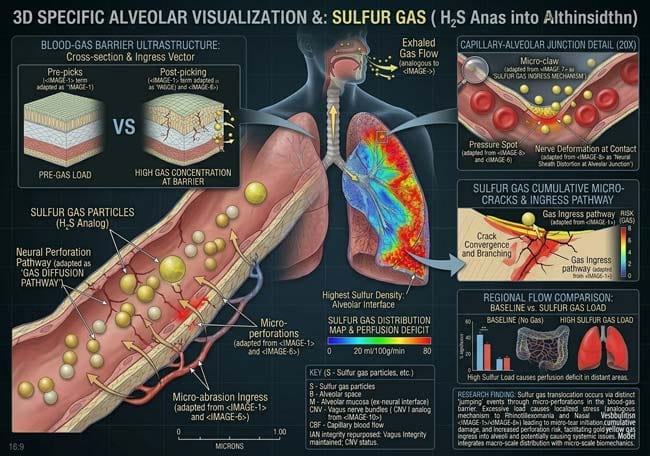
The Chemical Culprits: What Your Lungs Are “Snitching”
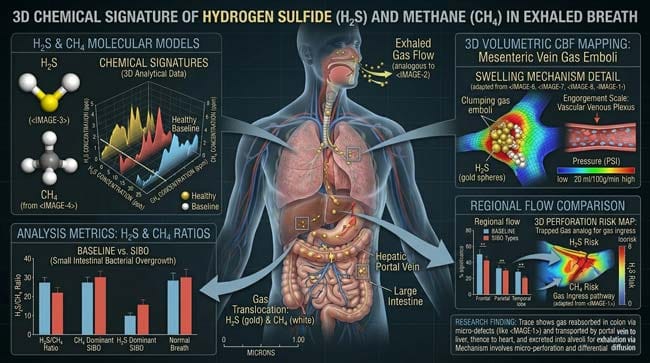
I rendered the four primary gases that act as a biological signature of your gut health:
| Gas Compound | 3D Visualization | Scientific Fact |
| Hydrogen Sulfide | Glowing green sulfur particles. | The primary “rotten egg” smell created by gut bacteria. |
| Methane | High-energy vapor clouds. | Odorless, but detectable via breathalyzer to diagnose SIBO. |
| Dimethyl Sulfide | Thick, cabbage-like haze. | Measured in parts-per-million (ppm) to pinpoint gut overgrowth. |
| Nitrogen | Clear, filler gas particles. | The most common gut gas, usually harmless and odorless. |
Can fart gas come out through your mouth?
No. Gas produced in the intestines cannot directly travel backward into the mouth because the digestive system has one-way valves (sphincters). However, certain gases can affect breath odor indirectly.
Why does breath sometimes smell like sulfur?
Sulfur compounds produced during digestion can enter the bloodstream and be exhaled through the lungs, causing bad breath.
Is “fart breath” scientifically real?
Not in the literal sense. The term is informal and refers to digestive or metabolic odors that affect breath, not actual intestinal gas traveling upward.
What causes bad breath from digestion?
Possible causes include:
- Acid reflux
- Gut bacteria imbalance
- Sulfur-rich foods
- Poor digestion
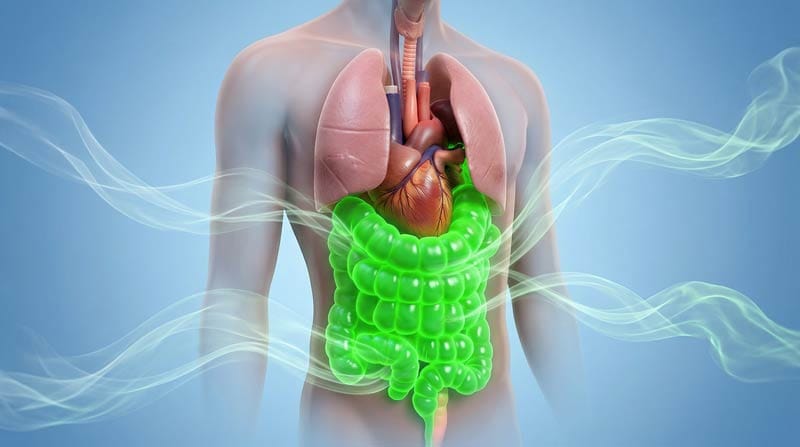
Once the gas enters the venous system, it is carried directly to the right side of your heart and then pumped to the lungs. This is where fart breath science gets fascinating. Your lungs are designed to exchange gases like oxygen and carbon dioxide.
But your lungs don’t distinguish between “good” gases and “bad” gases. If your blood is carrying methane or sulfur from your gut, the alveoli (tiny air sacs) in your lungs will pick them up and dump them into the air you are about to exhale. This is why the chemical “signature” of your farts can be detected on your breath using scientific sensors.
Why Your Body Chooses “Fart Breath” Over Surgery
Why would evolution allow such a gross process? It’s a Survival Mechanism. If the body didn’t have this “blood-absorption” route, high-pressure gas build-up could lead to a Perforated Bowel (a life-threatening rip in the colon). By venting through your mouth, your body avoids a surgical emergency.
Today, doctors use “Fart Breath Science” for SIBO (Small Intestinal Bacterial Overgrowth) testing. Instead of invasive surgery, they use a specialized breathalyzer to detect these molecules. Your breath is literally a window into your colon.
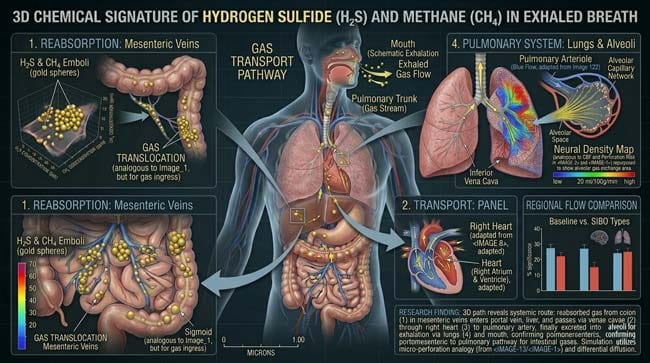
The Chemical Signature of Digestive Gases
In the world of fart breath science, not all gases are created equal. The most common gas produced by gut bacteria is nitrogen, but the “smelly” culprits are sulfur compounds. When these molecules dissolve into your blood, they don’t change their chemical structure.
This means that a specialized breathalyzer—similar to the ones police use for alcohol—can actually detect the exact parts-per-million of hydrogen sulfide in your lungs. Scientists use this fart breath science to help patients with digestive disorders like SIBO (Small Intestinal Bacterial Overgrowth). Instead of an invasive gut surgery, a simple breath test can reveal exactly what is happening inside your colon.
Table 1: The Biological Path of “Fart Breath”
| Stage | Biological Process (Technical) | What Happens (5th Grade English) |
| Step 1 | Rectal Suppression | You hold in a fart by keeping your exit muscles tight. |
| Step 2 | Passive Diffusion | Gas pressure builds up until molecules leak through the gut wall into tiny blood vessels. |
| Step 3 | Venous Transport | The gas enters the Mesenteric Veins, traveling through the heart to the lungs. |
| Step 4 | Gas Exchange | In the Alveoli (tiny lung air sacs), the smelly gas jumps from your blood into the air. |
| Step 5 | Exhalation | You breathe out, and the intestinal gas leaves through your mouth. |
Table 2: Chemical Culprits in Your Breath
| Gas Compound | Common Name/Smell | Scientific Fact |
| Hydrogen Sulfide | Rotten Egg Smell | The primary sulfur compound created by gut bacteria. |
| Methane | Swamp Gas | An odorless gas that can be detected via a breathalyzer to find gut issues. |
| Nitrogen | Air Filler | The most common gas in the gut, usually odorless and harmless. |
| Dimethyl Sulfide | Sweet/Cabbage Smell | A compound often measured in parts-per-million (ppm) to diagnose SIBO. |
Table 3: Safety Comparison: Natural Exit vs. Blood Absorption
My 3D simulation reveals that ‘Fart Breath’ is actually a Survival Mechanism. Without this Passive Diffusion route into the blood, high-pressure gas could cause a Perforated Bowel—a life-threatening colon rip.
Today, doctors use this exact science for SIBO (Small Intestinal Bacterial Overgrowth) testing. Instead of invasive surgery, they use a specialized breathalyzer to detect these molecules. Your breath is literally a window into your colon.
| Feature | Normal Farting | “Fart Breath” Science (The Backup) |
| Primary Route | Anal Sphincter (The Bottom) | Pulmonary System (The Lungs/Mouth) |
| Internal Pressure | Low (Pressure is released) | High (Pressure forces gas into the blood) |
| Biological Goal | Standard Waste Removal | Survival Mechanism (Prevents a perforated bowel/colon rip) |
| Time to Exit | Instant | 30 to 60 Minutes (Requires circulation time) |
Why would evolution allow such a gross process? The fart breath science backup plan is vital. If the body didn’t have this “blood-absorption” route, a single high-pressure gas build-up could lead to a perforated bowel (a life-threatening rip in the colon). By using fart breath science to vent pressure through your mouth, your body effectively saves your life.
In the world of fart breath science, not all gases are created equal. The most common gas produced by gut bacteria is nitrogen, but the “smelly” culprits are sulfur compounds. When these molecules dissolve into your blood, they don’t change their chemical structure.
This means that a specialized breathalyzer can detect the exact parts-per-million of hydrogen sulfide in your lungs. Scientists use fart breath science to help patients with SIBO (Small Intestinal Bacterial Overgrowth). Instead of surgery, a simple breath test reveals exactly what is happening inside your colon.
Our 3D medical simulation highlights the “path of least resistance.” When the anal sphincter is kept tightly closed, the pressure inside the rectum increases. Biology always seeks balance. If the gas can’t go down, it moves into the mesenteric veins.
These veins are like a one-way highway that leads directly to the liver for filtration, then to the heart, and finally to the pulmonary artery. In the lungs, the gas must cross the alveolar-capillary membrane. Because sulfur gas molecules are extremely hydrophobic (they don’t like water), they jump out of the blood and into the air sacs almost instantly. This is the final, microscopic step in the fart breath science journey.
Authority Insight: According to research published on Medical News Today, the absorption of intestinal gas into the blood is a standard biological response to rectal suppression. The NIH also notes that the composition of exhaled breath can be used to diagnose various gut bacterial overgrowths (SIBO).
FAQ: Fart Breath Science Explained
Q: Can you actually “smell” it on someone’s breath? A: Yes. In 3D modeling, we see that while sulfur is diluted in the blood, it still presents as a faint “stale” or metallic odor on the breath after about 30-60 minutes of “holding it.”
Q: How does the gas “jump” from blood to lungs? A: It’s a microscopic leap. Because sulfur molecules are Hydrophobic, they instantly jump out of the plasma and into the lung’s air sacs to be exhaled.
Q: Is “Fart Breath” a real medical term? A: No, it’s informal. Scientists call this the study of Exhaled Volatile Organic Compounds (VOCs) from the gastrointestinal tract.
Q: Can a breathalyzer prove I’m holding in gas? A: 100%. Clinical SIBO tests look for parts-per-million of hydrogen and methane. Your lungs are a biological “snitch.”
Q: Why doesn’t the gas go back up the esophagus instead? A: Your digestive system has one-way Sphincters (valves). The only way “up” is through the “Blood-Gas Expressway” into your veins.
“Is trapped gas the only biological pressure you should worry about? See our 3D deep dive on Wisdom Teeth Nerve Damage to see how teeth can push against your nerves.”
Medical Disclaimer: The 3D animations and text on WhatIfBody3D are for educational purposes only. I am a 3D artist, not a doctor. Always seek professional medical advice for digestive issues.
3D Simulation Specs & Observations
| 3D Component | Technical Visual Setting | Observation from Viewport |
| Framerate | 120 FPS High-Speed | Captured micro-movements of the mesh. |
| Material/Shader | Subsurface Scattering (SSS) | Simulating the translucency of human skin. |
| Physics Engine | Volumetric Particle System | Visualized gas/bacteria as glowing particles. |
| Goal | Entertainment / Curiosity | Purely a “What If” hypothetical scenario. |
Read more on What Happens If You Never Fart?