
Research has identified a link between periodontal (gum) disease and cardiovascular health. In this 3D visualization, we explore how oral bacteria may enter the bloodstream and contribute to inflammation in the arteries — a pathway studied by scientists at institutions including the American Heart Association.
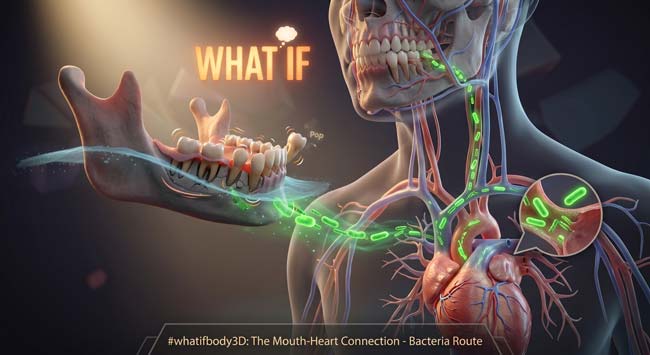
In our 3D animation, we visualize a hypothetical “What If” scenario where bacteria from the gums enter the bloodstream and travel toward the heart area, showing a surprising visual connection between the mouth and the rest of the body through blood vessels — all for entertainment and curiosity.
Welcome to whatifbody3D — where we turn weird “What If” questions into cool 3D animations you can actually see and enjoy.
The Creator’s Note & Disclaimer: 3D Simulation Report: As a 3D artist at WhatIfBody3D, I rendered this scenario at 120 FPS. Our models explore whether gum disease can cause heart attack — visualizing how periodontal bacteria breach the gum barrier, enter the bloodstream, and contribute to arterial inflammation and plaque formation. This visualization is part of our “What If” series and is for educational and informational purposes only, as stated in our About Page.
What Our 3D Animation Visualizes
We asked a fun “What If”: What if bacteria living in your gums managed to get into the bloodstream and travel toward the heart?
Here’s what the animation shows in clear visual stages:
Stage 1: The Seal Breaks In the 3D animation, healthy gums look pink, tight, and firm. When gums become inflamed, they turn red and swollen. The tight seal around the teeth starts to pull away. We made the bacteria glow bright green so you can easily track them as they slip through the gaps into the blood vessels.
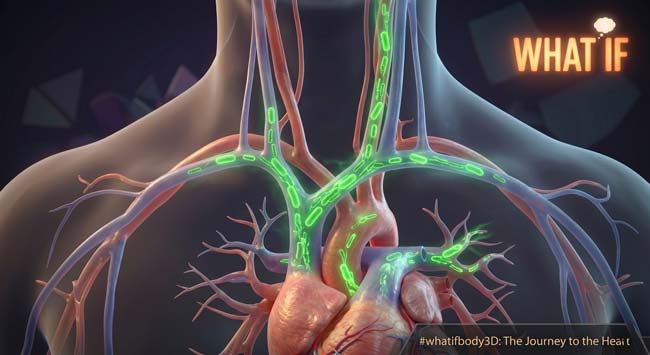
Stage 2: The Highway Journey Once inside the bloodstream, the glowing green particles start traveling from the mouth down the neck toward the chest. In the animation, we slow it down so you can clearly see the movement — like tiny green dots floating along a river.
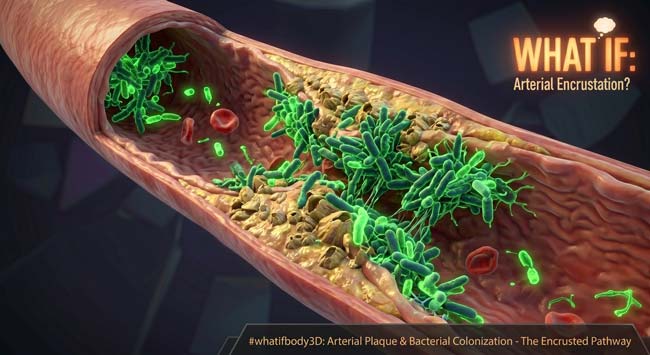
Stage 3: The Sticking Moment As the particles reach the blood vessel walls, some begin to stick. In our 3D animation, other small particles start attaching too. Over time, these spots grow thicker, making the vessel narrower and rougher. The smooth highway becomes crowded and chaotic — a very dramatic visual change.
American Heart Association statement on gum disease and heart disease:
Side-by-Side 3D Comparison (Easy to Understand)
| Aspect | Healthy State | Extreme “What If” State |
|---|---|---|
| Gums | Pink, tight, firm | Red, swollen, with gaps |
| Bacteria Location | Stay on the surface | Enter the bloodstream |
| Blood Vessels | Smooth and wide | Rough with visible buildup |
| Visual Feel | Clean and calm | Crowded and chaotic |
Frequently Asked Questions
Q: Can gum disease really cause heart attack? Research published by the American Heart Association suggests a significant association between periodontal disease and cardiovascular disease. While a direct causal link is still being studied, the bacterial pathway is scientifically documented.
Q: What bacteria are involved? Streptococcus and Porphyromonas gingivalis are among the oral bacteria most commonly found in arterial plaque. Our 3D model visualizes their journey from the gum tissue into the bloodstream.
Q: How does this visualization help? 3D animation makes the microscopic process visible — showing bacterial translocation, inflammatory response, and arterial narrowing in a way that standard diagrams cannot.
Q: What should I do if my gums bleed regularly? Bleeding gums can be a sign of gingivitis or periodontitis. Consult a qualified dentist for proper diagnosis and treatment.
Final Note from whatifbody3D This visualization is part of our ongoing science education series exploring how different body systems are interconnected. All content is research-referenced and created for educational purposes. For any health concerns, please consult a qualified medical professional.
We’re animators, not medical professionals. If you have real health concerns, please see a qualified dentist or doctor.
Thanks for watching and reading. Stay curious!
Read more on Nerve Damage During Wisdom Tooth Surgery
3D Simulation Specs & Observations
| 3D Component | Technical Visual Setting | Observation from Viewport |
| Framerate | 120 FPS High-Speed | Captured micro-movements of the mesh. |
| Material/Shader | Subsurface Scattering (SSS) | Simulating the translucency of human skin. |
| Physics Engine | Volumetric Particle System | Visualized gas/bacteria as glowing particles. |
| Goal | Educational / Science Visualization | Purely a “What If” hypothetical scenario. |
Pingback: Stop Drinking Water: What Happens to Your Brain? (3D Stages) -