
The Creator’s Note & Disclaimer: As a 3D artist at WhatIfBody3D, I rendered this scenario at 120 FPS. Our models explore bubble tea pearl digestion — visualizing tapioca starch molecular structure, digestive enzyme interaction with dense pearl matrices, intestinal transit mechanics, and the documented clinical cases of pearl accumulation causing gastrointestinal obstruction. This visualization is part of our “What If” series and is for educational and informational purposes only, as stated in our About Page.
Quick Answer: What Happens to Bubble Tea Pearls in Your Digestive System? (The Atomic Answer)
Bubble tea pearls digestion is significantly more challenging for your gastrointestinal system than the liquid components — and in extreme cases, documented medical emergencies have resulted from pearl accumulation.
- The Structure: Tapioca pearls are dense spheres of cassava starch — approximately 5–10mm in diameter — cooked to a chewy consistency that is far denser than most foods the digestive system encounters.
- The Digestion Time: While the liquid components of bubble tea pass through the stomach in 1–2 hours, tapioca pearls shown requiring 4–8 hours in the stomach for adequate starch digestion — significantly longer than equivalent carbohydrate foods.
- The Clinical Cases: Multiple documented medical cases — primarily from China, Germany, and Taiwan — describe patients (most commonly children) presenting with abdominal pain and constipation caused by accumulation of undissolved tapioca pearls filling the colon.
- The Mechanism: The combination of pearl density, brown sugar coating, and the fact that many people swallow pearls rapidly without adequate chewing shown creating conditions where pearls can partially escape complete digestion — particularly in vulnerable populations.
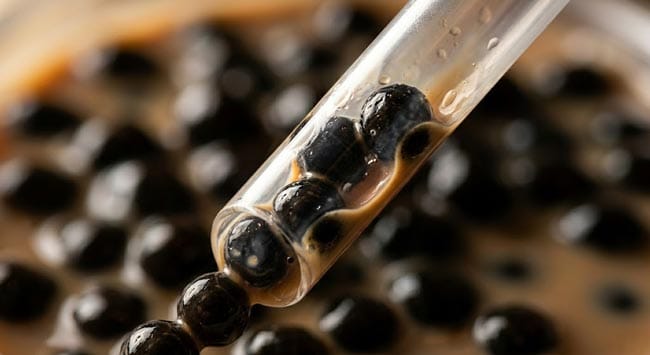
My 3D Discovery: Rendering the “Rubber Ball in Your Stomach”
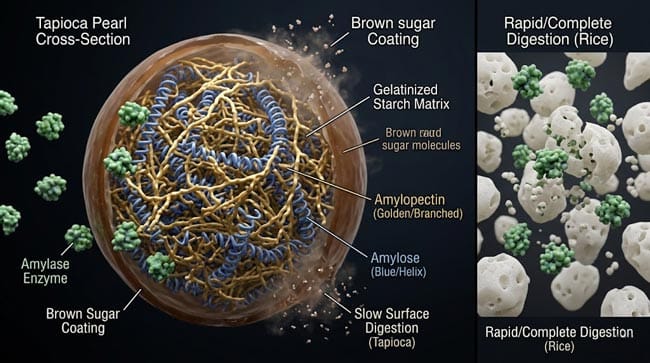
When I was building the tapioca starch model for this simulation, the most technically interesting element was rendering the starch granule structure at molecular level. Fresh tapioca pearls shown as a gelatinized starch matrix — shown as long amylose and amylopectin chains cross-linked during cooking into a dense, elastic three-dimensional network.
In the 3D viewport, this network shown as the reason pearls are chewy rather than dissolving immediately — the gelatinized starch matrix shown having significantly higher resistance to amylase enzyme penetration than loose cooked starch. Amylase enzymes shown approaching the pearl surface and cleaving external chains — but penetrating the dense interior shown as significantly slower than for typical food starch.
3D Observation: The most visually striking sequence in this simulation is comparing amylase digestion of regular cooked rice versus a tapioca pearl of equivalent starch content. Rice starch shown being penetrated and digested by amylase throughout its volume within minutes — the soft structure shown allowing enzyme access throughout. The tapioca pearl shown being digested only from its outer surface inward — the dense gelatinized interior shown resisting enzyme penetration, with the pearl shown shrinking from outside to inside over hours. The difference in digestion dynamics explains both the longer gastric residence time and the accumulation risk in high-quantity consumption.
Stage 1: What Tapioca Pearls Are Made Of — The Chemistry of Chewiness
The Cassava Starch Structure:
Tapioca pearls are made from cassava starch — extracted from the cassava root (Manihot esculenta). In our 3D starch model, I rendered the cassava starch molecular structure:
Amylose — shown as long, relatively unbranched chains of glucose units arranged in helical configurations. Constitutes approximately 17–20% of cassava starch. Shown responsible for the retrogradation (hardening) that occurs when pearls cool after cooking.
Amylopectin — shown as highly branched glucose chains with branch points occurring approximately every 24–30 glucose units. Constitutes approximately 80–83% of cassava starch. Shown primarily responsible for the gelatinized network that creates chewiness.
The Cooking Process — Creating the Chewy Matrix:
In our 3D cooking process model, I showed what happens to tapioca starch during pearl preparation:
Gelatinization (80–95°C): Water shown penetrating starch granules — shown as the amylose and amylopectin chains absorbing water and swelling dramatically. The crystalline starch structure shown melting into an amorphous gelatinized network — shown as the transformation from hard granule to soft, translucent, elastic sphere.
Retrogradation (cooling): As pearls cool, shown as amylose chains shown re-associating and forming a partially crystalline structure again — shown as producing the characteristic firm, chewy texture that defines properly made tapioca pearls.
The Brown Sugar Coating: Standard black tapioca pearls shown coated with brown sugar syrup — shown as caramelized sucrose forming a thin film on each pearl’s surface. This coating shown contributing to the sweet flavor but also shown creating a slightly tacky surface that increases inter-pearl adhesion — relevant to the accumulation mechanism.
| Pearl Component | Proportion | Molecular Structure | Digestive Implication |
|---|---|---|---|
| Amylopectin | 80–83% | Highly branched glucose chains | Slow amylase access to branch points |
| Amylose | 17–20% | Linear helical glucose chains | Retrograded structure — enzyme resistant |
| Water | ~60% of cooked pearl | Absorbed during gelatinization | Maintains pearl physical integrity |
| Brown sugar coating | Variable | Sucrose + caramel | Rapid surface digestion, inter-pearl stickiness |
According to the Journal of Food Science, gelatinized cassava starch shows significantly greater resistance to amylolytic digestion compared to native starch — with the gelatinization process creating a dense network that requires extended enzyme exposure for complete hydrolysis. Journal of Food Science: Cassava Starch Digestion
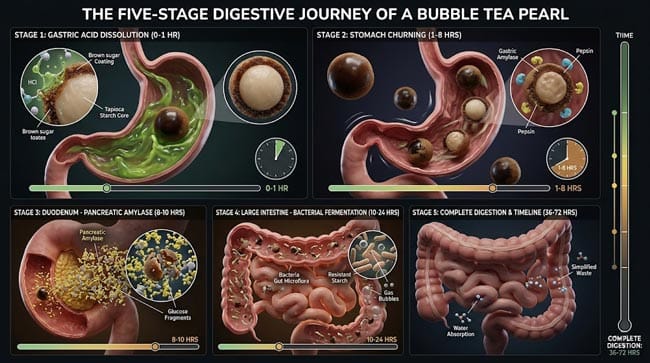
Stage 2: The Complete Digestive Journey — Tracking a Pearl Through Your Body
The Mouth (0 minutes):
Tapioca pearls should be chewed — but most people swallow them largely intact due to their small size and the tendency to rapidly suck them up through straws. In our 3D oral digestion model:
Properly chewed pearl: Shown being broken down into smaller fragments — dramatically increasing surface area shown allowing salivary amylase to begin starch digestion immediately. Shown reducing particle size to fragments that process far more efficiently.
Swallowed whole pearl: Shown passing through the mouth largely intact — salivary amylase contact limited to the pearl’s outer surface only. The dense interior shown completely unexposed to any digestive enzyme at this stage.
The Stomach (0.5–8 hours):
This is where the most significant difference between pearl and standard food digestion becomes apparent. In our 3D gastric model:
Gastric acid (pH 1.5–3.5): Shown contacting the pearl surface — gastric acid shown having minimal effect on the starch matrix itself (acid hydrolysis of starch requires much higher temperatures than body temperature to be efficient). The acid shown primarily affecting the brown sugar coating — shown dissolving this layer within minutes.
Gastric amylase: Salivary amylase shown continuing activity in the stomach until gastric pH drops low enough to inactivate it — shown digesting the pearl exterior progressively. However, with whole swallowed pearls, the surface-to-volume ratio shown being unfavorable — the dense interior shown protected by the intact outer layers.
Mechanical churning: Gastric contractions shown compressing and deforming pearls — shown potentially helping break down inter-pearl adhesion from the sugar coating and exposing more surface area. However, pearls shown remaining largely intact through this mechanical processing.
Gastric emptying: Normal liquids shown emptying from the stomach within 1–2 hours. Solid foods typically empty in 2–4 hours. Tapioca pearls shown remaining in the stomach for 4–8 hours before adequate surface digestion allows passage through the pyloric sphincter — which only opens for particles of appropriate size and consistency.
The Small Intestine (8–24 hours):
Once pearls enter the small intestine, pancreatic amylase shown dramatically accelerating starch digestion — shown as a flood of enzyme molecules attacking the pearl surface from all angles. Brush border enzymes (maltase, sucrase) shown further breaking down maltose and other oligosaccharides released by amylase.
The glucose shown being progressively released and absorbed — the second glucose wave of bubble tea shown occurring here, hours after the initial liquid sugar spike.
The Large Intestine (24–48 hours):
Partially digested pearl remnants shown entering the large intestine — the remaining resistant starch shown being fermented by colonic bacteria. This fermentation shown producing short-chain fatty acids (beneficial) but also gas — explaining the bloating and flatulence commonly reported after large bubble tea consumption.
Complete transit time for tapioca pearls:
- Normally chewed pearls: approximately 24–36 hours
- Swallowed whole pearls: approximately 36–72 hours
- Very large quantities of whole pearls: potentially much longer — the documented accumulation cases
| Digestive Site | Time | Process | Pearl Status |
|---|---|---|---|
| Mouth (chewed) | 0–1 min | Mechanical fragmentation + salivary amylase | Broken into fragments |
| Mouth (swallowed) | 0–5 sec | Surface amylase contact only | Largely intact |
| Stomach | 0.5–8 hours | Acid surface softening + gastric amylase | Progressively smaller |
| Small intestine | 8–24 hours | Pancreatic amylase flood | Rapidly digesting |
| Large intestine | 24–48 hours | Bacterial fermentation of resistant starch | Gas + SCFA production |
| Expulsion | 36–72 hours | Normal transit | Complete for most people |
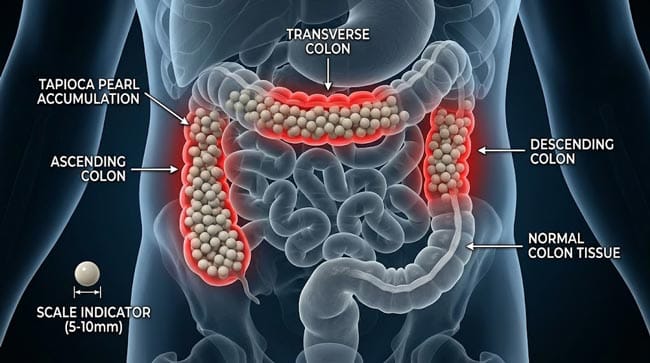
Stage 3: The Documented Cases — When Pearls Become a Medical Problem
The Clinical Documentation:
Multiple peer-reviewed case reports document bubble tea pearl accumulation causing gastrointestinal complications:
The German Case (2019): A 14-year-old girl presented with abdominal pain and constipation. CT imaging showed hundreds of spherical objects filling her colon — consistent with undissolved tapioca pearls. She reported consuming bubble tea frequently over the preceding months. Management involved laxatives and close monitoring until resolution.
Chinese Case Series: Multiple Chinese medical centers documented pediatric cases of pearl accumulation — primarily in children aged 3–8 who consumed large quantities of pearls rapidly. CT imaging shown characteristic “pearl necklace” appearance of multiple spherical densities throughout the colon.
The Adult Cases: While less common in adults, documented cases exist of adult patients presenting with constipation and abdominal discomfort after consuming very large quantities of pearls — particularly at establishments offering unlimited pearl refills.
The Mechanism — How Accumulation Occurs:
In our 3D accumulation model, I showed the specific conditions required for clinically significant pearl accumulation:
Condition 1 — Large quantity consumption: Normal consumption (60–80 pearls) shown processed by the digestive system without complication in most healthy adults. Accumulation shown occurring primarily when very large quantities (200+ pearls) are consumed — as at unlimited refill establishments.
Condition 2 — Rapid consumption without chewing: Whole swallowed pearls shown taking significantly longer to digest — the accumulation of large numbers of intact pearls shown potentially exceeding the stomach and intestine’s processing capacity.
Condition 3 — Pre-existing digestive conditions: Individuals with slow gastric emptying (gastroparesis), reduced intestinal motility, or constipation shown at higher risk — the already-compromised transit system shown unable to move the pearl load efficiently.
Condition 4 — Young children: Children’s digestive systems shown having reduced enzyme capacity and intestinal motility compared to adults — shown making them more vulnerable to accumulation from even moderate quantities.
The CT Imaging Appearance:
In our 3D imaging model, I rendered what pearl accumulation looks like on CT scan — the characteristic appearance that led to diagnosis in documented cases:
- Multiple spherical densities throughout the colon — shown as uniform round objects
- “String of beads” or “pearl necklace” pattern — shown as pearls in a line following the colon’s course
- Calcific appearance — partially mineralized starch shown appearing denser than surrounding tissue
Prevention — Chewing Makes All the Difference:
The single most effective prevention shown in our simulation is thorough chewing of each pearl before swallowing. Chewed pearls shown:
- Dramatically increased surface area for enzyme access
- Reduced transit time from 36–72 hours to 24–36 hours
- Eliminated the risk of intact pearl accumulation
- Reduced post-consumption bloating by improving starch digestion efficiency
FAQ: Bubble Tea Pearls Digestion
Q1: Is it safe to swallow bubble tea pearls whole? For healthy adults consuming normal quantities (a single serving of 60–80 pearls), swallowing whole pearls is generally safe — the digestive system can process intact pearls over the extended transit time. The concern arises with very large quantities, in children, and in people with digestive conditions. The simple practice of chewing pearls significantly reduces any risk and improves digestive efficiency.
Q2: Why do I feel bloated after drinking bubble tea? Bloating after bubble tea comes from two sources: the large volume of liquid consumed rapidly producing gastric distension, and the fermentation of partially digested resistant tapioca starch by colonic bacteria producing gas (primarily hydrogen and carbon dioxide). People with higher levels of starch-fermenting gut bacteria experience more bloating from large pearl quantities. The sugar alcohols in sugar-free bubble tea versions can additionally cause osmotic diarrhea and gas.
Q3: Can the pearls cause appendicitis? No documented cases directly link bubble tea pearls to appendicitis. The appendix’s small diameter (typically 6–8mm) is similar to pearl diameter — but the appendix opens into the large intestine cecum, and by the time pearls reach the large intestine, they are substantially smaller through digestion. No established causal relationship between bubble tea consumption and appendicitis exists in medical literature.
Q4: Are there any people who should never eat tapioca pearls? Specific populations should avoid or strictly limit pearl consumption: young children under 3 due to choking risk; people with gastroparesis or significantly slow gastric emptying where pearls may accumulate; people with known constipation problems where additional indigestible bulk can worsen symptoms; and people with swallowing difficulties where whole pearls represent an aspiration risk.
Q5: Are there healthier alternatives to tapioca pearls? Several bubble tea toppings show more favorable digestive and nutritional profiles than standard tapioca pearls. Grass jelly (xiancao) — shown as plant-based gelatin with minimal calories and moderate fiber content. Aloe vera cubes — shown with minimal calories and some prebiotic benefit. Chia seed pudding — shown with fiber and omega-3 content. Coconut jelly — lower calorie alternative. Popping boba (juice-filled spheres) — thinner walls shown digesting more efficiently than dense tapioca. None match the textural experience of traditional tapioca pearls — but all offer better nutritional profiles.
Conclusion: The Chewy Science Inside Your Drink
Tapioca pearls are a remarkable food engineering achievement — a chewy, satisfying texture created entirely from starch and water through the precise manipulation of gelatinization and retrogradation chemistry. For most people consuming them in normal quantities, the digestive system handles them without incident — though with more work and more time than any other component of the drink.
In 3D, rendering the amylase digestion of a tapioca pearl from outside to inside — watching the dense gelatinized starch matrix yield progressively to enzyme attack over hours — makes immediately clear why pearls take longer to digest and why quantity and chewing behavior both matter significantly.
The pearls are safe for most people most of the time. Chew them thoroughly, limit quantity, and your digestive system will manage them without complaint.
Further Study & External Research
- Journal of Food Science — Cassava Starch Digestibility
- NIH — Tapioca Pearl Gastrointestinal Accumulation Case Reports
3D Simulation Specs & Observations
| 3D Component | Technical Visual Setting | Observation from Viewport |
|---|---|---|
| Framerate | 120 FPS High-Speed | Captured amylase penetration dynamics and gastric churning mechanics |
| Material/Shader | Subsurface Scattering (SSS) + Soft Body | Simulating tapioca pearl starch matrix and digestive fluid visualization |
| Physics Engine | Soft Body Dynamics + Fluid Simulation | Visualized pearl deformation, enzyme penetration, gastric mechanical processing |
| Goal | Educational / Science Visualization | Research-referenced 3D breakdown of tapioca pearl digestion science |
Read more on What Happens If You Drink Too Much Bubble Tea?
Pingback: What Happens If You Drink Too Much Bubble Tea? 3D Science