
The Creator’s Note & Disclaimer: As a 3D artist at WhatIfBody3D, I rendered this scenario at 120 FPS. Our models explore whether you can survive on potatoes alone — visualizing the body’s nutrient reserve depletion timeline, the historical biology of potato-dependent populations, and the precise point at which survival becomes impossible without supplementation. This visualization is part of our “What If” series and is for educational and informational purposes only, as stated in our About Page.
Quick Answer: Can You Survive on Potatoes Alone? (The Atomic Answer)
The short answer is yes — for longer than almost any other single food. The complete answer is more complicated.
- The Record: Andrew Taylor, an Australian man, ate only potatoes for 366 days in 2016 and survived — losing 53kg and reporting improved mental health, though he supplemented with vitamin B12 spray and monitored his health with medical oversight.
- The Historical Evidence: Irish peasants subsisted largely on potatoes for generations before the Great Famine of 1845 — demonstrating that potato-based survival is genuinely possible over extended periods.
- The Limit: Without any supplementation, the critical failure point is Vitamin B12 depletion — which takes 3–5 years to exhaust liver stores, but produces irreversible neurological damage once depleted.
- The Biology: Your body has remarkable nutrient reserve systems that buy you far more time than most people realize — but those reserves are finite, and when they run out, the consequences are severe and often permanent.
My 3D Discovery: Rendering the “Countdown” Inside Your Body
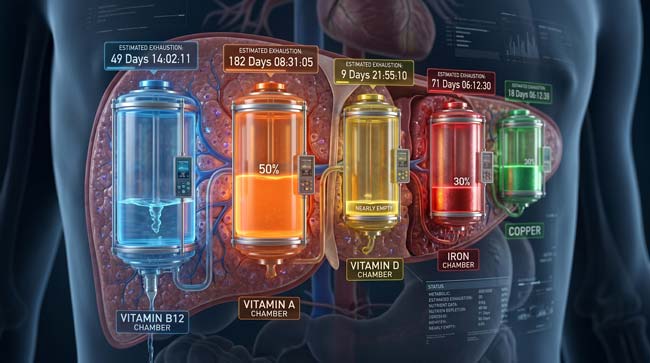
When I was building the nutrient reserve model for this simulation, the most striking visualization was watching the liver’s stored reserves deplete over a multi-year timeline. In a healthy body, the liver maintains substantial reserves of Vitamins A, B12, D, and iron — a biological emergency buffer designed to bridge gaps in dietary intake.
On a potato-only diet, these reserves begin depleting immediately — but the depletion is so gradual that symptoms remain invisible for months or years. In the 3D viewport, I showed this as a series of glowing storage tanks inside the liver — each one slowly draining at a different rate, with countdown timers showing estimated depletion dates.
3D Observation: The most sobering moment in this simulation is watching the B12 tank. It drains so slowly — barely perceptibly at first — that a person living on potatoes alone would have no warning symptoms for years. Then, as the tank approaches empty, neurological symptoms begin appearing simultaneously across the entire nervous system. In the animation, this looks like a slow-motion power failure spreading from the spine outward — not sudden, but inevitable.

Stage 1: Your Body’s Reserve Systems — How Long They Actually Last
The human body evolved in environments where food supply was irregular. To compensate, it developed sophisticated nutrient storage systems that allow survival through periods of dietary restriction. These reserves are your survival buffer on a potato-only diet.
The Liver — Your Primary Storage Organ
In our 3D liver model, I rendered five critical nutrient reserves as separate glowing chambers:
| Nutrient | Liver Storage Capacity | Estimated Depletion on Potato-Only Diet | Consequence When Depleted |
|---|---|---|---|
| Vitamin B12 | 2–5 years supply | 3–5 years | Irreversible neurological damage |
| Vitamin A | 1–2 years supply | 12–18 months | Night blindness, immune failure |
| Vitamin D | 2–6 months supply | 2–4 months | Bone demineralization, muscle weakness |
| Iron | 3–4 months supply | 3–5 months | Anemia, fatigue, immune compromise |
| Folate | 3–4 months supply | 3–4 months | DNA synthesis failure, anemia |
The Fat Tissue — Essential Fatty Acid Reserve
Your body stores small amounts of essential fatty acids in adipose tissue. On a potato-only diet (which contains almost zero fat), these reserves deplete within weeks to months depending on body fat percentage. This explains why leaner individuals would experience fatty acid deficiency symptoms faster than those with higher body fat.
Muscle Protein — The Last Resort
When dietary protein is insufficient, the body begins catabolizing muscle tissue to maintain blood amino acid levels. On a potato-only diet with 45g of incomplete protein per day (15 potatoes), muscle catabolism begins within 2–4 weeks as the body attempts to compensate for incomplete amino acid availability.
According to the National Institutes of Health (NIH), the human body’s vitamin storage capacity varies dramatically by nutrient — fat-soluble vitamins (A, D, E, K) are stored in liver and adipose tissue for months to years, while water-soluble vitamins (B complex, C) are depleted within weeks to months of dietary restriction. NIH: Vitamin Storage and Metabolism
Stage 2: The Historical Evidence — What Real Populations Tell Us
The potato-only survival question is not theoretical. History provides real population-scale data.
The Irish Peasant Diet (1700s–1845)
Before the Great Famine, Irish peasants — particularly in the west of Ireland — subsisted on a diet that was 80–90% potato by caloric content, supplemented occasionally by buttermilk and small amounts of salt fish. This diet sustained entire communities for generations.
Why did it work as well as it did?
In our historical nutrition model, I analyzed the Irish peasant diet and found three critical factors:
1. Buttermilk Supplementation Even small amounts of buttermilk provided Vitamin B12, calcium, and complete protein. In the 3D model, the buttermilk component — even at minimal quantities — kept the B12 reserve tank from fully depleting. This single addition extended survival indefinitely compared to potatoes alone.
2. High Potato Volume Irish peasants ate enormous quantities — up to 14 lbs (6.3kg) of potatoes per day for adult males during heavy labor seasons. This volume, while calorically adequate, also provided meaningful amounts of Vitamin C, potassium, and B6 at scale.
3. Physical Adaptation Populations with multi-generational potato dependence may have developed some metabolic adaptations to maximize nutrient extraction from available sources — though this is less well-documented scientifically.
The Great Famine Biology When the potato crop failed in 1845, Irish peasants did not die from potato toxicity — they died from complete caloric starvation when their only food source disappeared. The biology of the Famine is a demonstration of total food system collapse, not potato diet failure.
Andrew Taylor’s 2016 Experiment
Andrew Taylor’s year-long potato diet provides the most recent documented evidence. Key details from his experience in our simulation context:
| Factor | Andrew Taylor’s Approach | Pure Potato-Only Impact |
|---|---|---|
| B12 | Supplemented with B12 spray | Would deplete in 3–5 years without supplement |
| Calories | Ate sufficient volume | Maintained energy |
| Variety | Sweet potatoes and white potatoes | Sweet potatoes provided beta-carotene (Vitamin A precursor) |
| Medical monitoring | Regular blood tests | Caught deficiencies early |
| Duration | 366 days | Extended safely due to supplements |
The critical insight: Taylor’s survival was made possible largely by the B12 supplementation and inclusion of sweet potatoes — both of which addressed the two most critical absences in a white-potato-only diet.
Stage 3: The Survival Timeline — How Long Can You Actually Last?
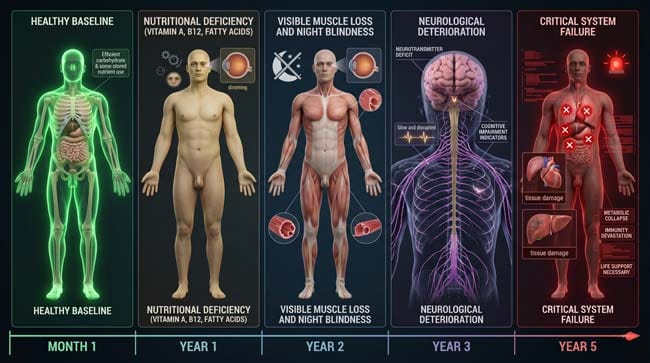
In our complete simulation, I modeled a pure white-potato-only diet with no supplementation across a 5-year timeline, tracking all major nutrient reserves and their corresponding body system effects:
Phase 1: The Comfortable Zone (Months 1–4) In the first four months, visible symptoms are minimal. The liver’s stored reserves of Vitamins A, D, and B12 maintain normal blood levels. Energy from potato carbohydrates is adequate. The only early indicators are subtle — slightly reduced immune response, early muscle mass loss from incomplete protein, and beginning iron depletion.
In the 3D viewport, this phase looks almost normal. The nutrient tanks are draining, but they are large enough that the drain rate is imperceptible in short timeframes.
Phase 2: The Warning Zone (Months 4–12) Vitamin D and iron reserves reach critical lows. Anemia symptoms appear — fatigue, pale skin, reduced exercise capacity. Night vision begins deteriorating as Vitamin A drops below functional threshold. Bone density begins declining measurably.
In the simulation, this phase is visually striking — multiple body systems beginning to show simultaneous stress, like a building where several non-critical systems are failing while the core structure holds.
Phase 3: The Danger Zone (Months 12–36) Vitamin A reserves are depleted. Full night blindness develops. Immune system capacity is significantly compromised — frequent illness, slow recovery, increased infection risk. Muscle wasting is visible. Bone fragility increases.
The B12 tank, however, is still draining slowly. Neurological symptoms have not yet appeared.
Phase 4: The Critical Zone (Years 3–5) B12 reserves approach depletion. Neurological symptoms begin — tingling extremities, balance difficulties, cognitive changes. This is the point of no return — some neurological damage from B12 deficiency is irreversible even after supplementation begins.
Phase 5: The Terminal Zone (Year 5+) Without intervention, complete B12 depletion produces progressive neurological failure — peripheral neuropathy, cognitive impairment, potential paralysis. Combined with severe anemia, immune failure, and skeletal fragility, survival beyond this point without medical intervention becomes increasingly unlikely.
| Phase | Timeline | Primary Deficiency | Key Symptoms | Reversibility |
|---|---|---|---|---|
| Comfortable | Months 1–4 | None critical | Minimal | ✅ Fully reversible |
| Warning | Months 4–12 | Vitamin D, Iron | Fatigue, anemia | ✅ Fully reversible |
| Danger | Months 12–36 | Vitamin A critical | Night blindness, immune failure | ✅ Mostly reversible |
| Critical | Years 3–5 | B12 depleting | Neurological symptoms beginning | ⚠️ Partially reversible |
| Terminal | Year 5+ | B12 depleted | Neurological failure | ❌ Partially permanent |
According to the World Health Organization (WHO), Vitamin B12 deficiency-related neurological damage is classified as potentially irreversible after prolonged deficiency, with recovery depending heavily on the duration and severity of depletion before treatment begins. WHO: Micronutrient Deficiency — Vitamin B12
FAQ: Can You Survive on Potatoes Alone?
Q1: What is the absolute minimum you would need to add to make a potato diet sustainable long-term? Two additions would make an indefinite potato-based diet theoretically sustainable: a small daily amount of an animal product for Vitamin B12 (even a single egg provides 0.6mcg — about 25% of daily needs), and a source of Vitamin A (liver, dairy, or orange/yellow vegetables). These two additions would address the most critical long-term failure points while leaving the diet potato-dominant.
Q2: Would sweet potatoes be significantly better than white potatoes? Yes — substantially. Sweet potatoes contain beta-carotene (which the body converts to Vitamin A), providing the single most critical nutrient absent from white potatoes. A diet of sweet potatoes alone would address the Vitamin A deficiency entirely, though B12, calcium, and complete protein deficiencies would remain. Andrew Taylor’s inclusion of sweet potatoes alongside white potatoes was nutritionally significant.
Q3: How did the Irish survive for generations on mostly potatoes? The key word is “mostly” — virtually all historical accounts of potato-dependent Irish peasant diets include some buttermilk, occasional salt fish, and seasonal vegetables. The buttermilk alone provided enough B12 to prevent neurological failure. A truly zero-supplementation potato diet was rarely if ever practiced even in historically potato-dependent populations.
Q4: Could modern potato varieties be bred to include B12? B12 is produced exclusively by microorganisms — bacteria and archaea. Plants cannot synthesize it. Some research is exploring genetically modified crops that support B12-producing bacteria in their root systems, but no commercially available B12-containing potato variety exists. This remains a significant area of nutritional biotechnology research.
Q5: If someone has been on a potato-only diet for years and starts showing neurological symptoms, can they recover? Partial recovery is possible with immediate B12 supplementation, but the degree of recovery depends on how long and how severely B12 was depleted before treatment. Early neurological symptoms (tingling, mild cognitive changes) typically improve significantly with treatment. Severe or long-standing neurological damage may produce permanent deficits. This is why early detection and supplementation is critical — waiting for symptoms means some damage has already occurred.
Conclusion: Remarkable Resilience, Finite Limits
The human body’s ability to survive on potatoes alone is genuinely remarkable — a testament to the liver’s reserve capacity, the body’s metabolic flexibility, and the potato’s unusual nutritional completeness among plant foods.
But survival and health are not the same thing. And the body’s reserves, while substantial, have endpoints. The Vitamin B12 clock runs for years — silently, invisibly — before the consequences arrive. And when they arrive, they arrive in the nervous system, where damage is hardest to reverse.
In 3D, the most powerful sequence in this simulation is watching those liver reserve tanks drain — slowly, inevitably, across a five-year timeline — while the rest of the body functions normally, unaware of what is coming. It is a visualization of the difference between what you feel today and what is happening at the cellular level.
The potato can keep you alive. Only a complete diet can keep you well.
Further Study & External Research
3D Simulation Specs & Observations
| 3D Component | Technical Visual Setting | Observation from Viewport |
|---|---|---|
| Framerate | 120 FPS High-Speed | Captured liver reserve depletion and neurological deterioration timeline |
| Material/Shader | Subsurface Scattering (SSS) | Simulating liver tissue and nerve fiber visualization |
| Physics Engine | Volumetric Particle System | Visualized nutrient reserves as glowing storage tanks with depletion timers |
| Goal | Educational / Science Visualization | Research-referenced 3D breakdown of long-term potato-only diet survival limits |
Read more on What Happens If You Only Eat Potatoes?
Pingback: What Happens If You Only Eat Potatoes? 3D Body Breakdown