
The Creator’s Note & Disclaimer: As a 3D artist at WhatIfBody3D, I rendered this scenario at 120 FPS. Our models explore why spicy food burns your mouth — visualizing capsaicin molecules binding to TRPV1 receptors, false fire signals reaching the brain, and the science of cooling the burn. This visualization is part of our “What If” series and is for educational and informational purposes only, as stated in our About Page.
Quick Answer: Why Does Spicy Food Burn Your Mouth? (The Atomic Answer)
Your mouth is not actually on fire. There is no heat, no tissue damage, no real burning happening. And yet the pain is completely real.
Capsaicin — the active compound in chili peppers — is one of nature’s most sophisticated biological tricks.
- The Deception: Capsaicin binds directly to your TRPV1 receptors — the same receptors that detect actual heat above 42°C (108°F). Your brain receives an identical signal whether the trigger is a ghost pepper or a lit match.
- The Signal: In our 3D simulation, capsaicin molecules lock onto TRPV1 receptors like a key into a lock, triggering a full heat alarm cascade that travels from your tongue to your brain in milliseconds.
- The Illusion: Your mouth genuinely believes it is burning. The sweating, the tears, the desperate reaching for milk — these are real physiological responses to what your nervous system is convinced is a thermal emergency.
- The Fix: Capsaicin is a fat-soluble molecule. Water cannot wash it away. Only fat-based liquids like milk or yogurt can physically bind to capsaicin and remove it from your receptors.
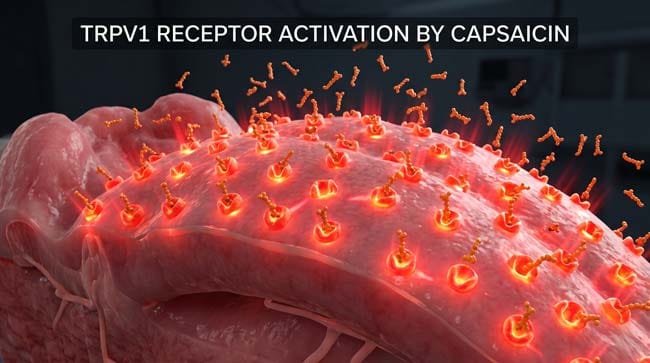
My 3D Discovery: Rendering the “False Fire Alarm”
When I was building the molecular model for capsaicin in this simulation, the most striking thing was how perfectly it fits the TRPV1 receptor. In the 3D viewport, watching a capsaicin molecule dock into a receptor looks like watching a precisely engineered key slide into a lock.
The receptor cannot tell the difference. In my animation, the moment capsaicin binds, the receptor fires an identical electrical signal to what actual 42°C heat would produce. The signal travels up the Lingual Nerve, through the Trigeminal Ganglion, and into the brain’s pain processing center — all within milliseconds.
3D Observation: What makes this simulation so visually dramatic is the cascade effect. One capsaicin molecule activates one receptor. But chili pepper juice contains millions of capsaicin molecules. In the viewport, you can see the entire tongue surface light up simultaneously — thousands of TRPV1 receptors firing at once, creating what looks like a city-wide fire alarm going off across every district at the same time.
Stage 1: The Capsaicin Molecule — Nature’s Perfect Deceiver
Capsaicin (C₁₈H₂₇NO₃) is produced by chili peppers as a natural defense against mammals. Birds cannot detect it — they lack functional TRPV1 receptors for capsaicin — which is why peppers use birds for seed dispersal while discouraging mammals from eating them.
In our 3D molecular model, capsaicin has a distinctive shape — a long hydrophobic tail attached to a vanillyl head group. This shape is the key to everything.
| Chili Pepper | Scoville Heat Units | Capsaicin Concentration | TRPV1 Activation Level |
|---|---|---|---|
| Bell Pepper | 0 SHU | 0% | None |
| Jalapeño | 2,500–8,000 SHU | Low | Mild receptor activation |
| Habanero | 100,000–350,000 SHU | Medium-High | Intense receptor activation |
| Ghost Pepper | 1,000,000+ SHU | Very High | Extreme receptor saturation |
| Pure Capsaicin | 16,000,000 SHU | 100% | Maximum possible activation |
In the 3D viewport, I used color-coded intensity mapping to show receptor activation levels. A jalapeño produces a warm orange glow across the tongue surface. A ghost pepper turns the entire oral cavity a pulsing, saturated red — every TRPV1 receptor firing at maximum capacity simultaneously.
According to the National Institutes of Health (NIH), TRPV1 receptors are thermosensitive ion channels that respond to temperatures above 43°C and to capsaicinoids — explaining precisely why the brain cannot distinguish between genuine heat and capsaicin stimulation. NIH: TRPV1 and Capsaicin
Stage 2: The TRPV1 Receptor — Your Brain’s Broken Fire Detector
TRPV1 stands for Transient Receptor Potential Vanilloid 1. It is a protein channel embedded in the membrane of sensory neurons throughout your mouth, throat, and digestive tract.
Under normal conditions, TRPV1 serves a critical protective function — it detects dangerous heat and triggers pain to make you stop touching or consuming something hot enough to cause tissue damage.
Capsaicin exploits this system completely.
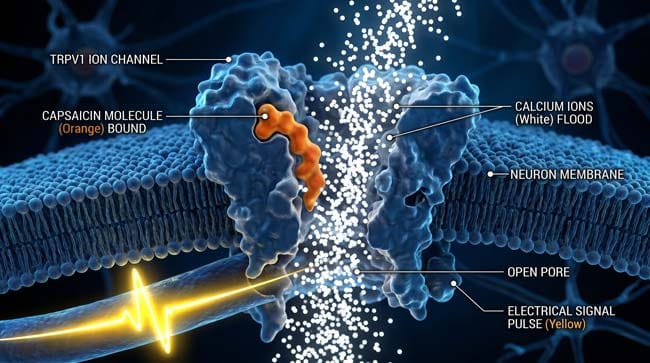
In our 3D molecular simulation, I rendered the TRPV1 receptor as a cylindrical protein channel sitting in the neuron membrane. Here is what happens step by step:
Step 1 — Capsaicin Arrives Capsaicin molecules dissolve into the fatty membrane surrounding the neuron and approach the TRPV1 receptor from the inside of the membrane — a route that actual heat cannot take.
Step 2 — The Lock Opens Capsaicin binds to a specific site inside the TRPV1 channel, causing it to change shape and open. In the animation, you see the channel gates swing open as if receiving an authorized emergency signal.
Step 3 — Calcium Floods In Once open, calcium ions rush through the channel into the neuron. This is the electrical trigger — the same cascade that actual high heat would produce.
Step 4 — The Brain Receives “FIRE” The neuron fires, sending a pain signal up the Lingual Nerve to the Trigeminal Ganglion and into the brain’s Somatosensory Cortex and Anterior Cingulate Cortex — the areas that process both physical pain and emotional response to pain.
| Stage | 3D Visual | Biological Event |
|---|---|---|
| Capsaicin contact | Orange molecules approaching neuron surface | Capsaicin dissolving into cell membrane |
| Receptor binding | Key sliding into lock animation | Capsaicin docking at TRPV1 binding site |
| Channel opening | Gates swinging open, calcium flood | Ion channel activation |
| Signal transmission | Bright electrical pulse traveling up nerve | Pain signal reaching brain |
| Brain response | Entire pain center lighting red | “FIRE” alarm processed as real thermal threat |
Stage 3: Why Milk Works — The Fat-Soluble Science
Water makes spicy burning worse. Most people discover this instinctively and reach for milk instead. In our 3D simulation, the reason becomes visually obvious.
Capsaicin is hydrophobic — it repels water.
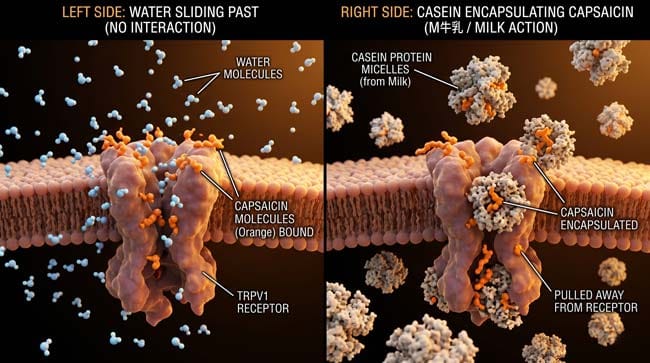
When you drink water after eating something spicy, in the 3D viewport you can see the water molecules sliding past the capsaicin molecules without interacting. The capsaicin stays locked onto the TRPV1 receptors. The burning continues — or briefly intensifies as the water spreads the capsaicin to new areas of the mouth.
Milk contains casein — a fat-based protein that binds to capsaicin.
In the animation, casein molecules from milk act like molecular sponges. You can see them surrounding capsaicin molecules, encapsulating them, and physically pulling them away from the TRPV1 receptors. Once unbound from the receptor, the channel closes, calcium stops flowing, and the pain signal ends.
| Liquid | Capsaicin Interaction | Effect on Burning |
|---|---|---|
| Water | No binding — capsaicin repelled | No relief, may spread burn |
| Beer/alcohol | Partial fat solubility | Minimal relief |
| Milk (whole) | Casein binds capsaicin strongly | Effective relief |
| Yogurt | High casein content | Very effective relief |
| Ice cream | Fat + casein + cold | Most effective combination |
| Bread | Physical absorption | Moderate mechanical relief |
According to the American Chemical Society, casein proteins in dairy products are structurally similar to detergent molecules — they have one fat-loving end that grabs capsaicin and one water-loving end that allows the complex to be washed away. ACS: Why Milk Relieves Spicy Burns
FAQ: Why Does Spicy Food Burn Your Mouth?
Q1: Does eating spicy food regularly make you more tolerant to it? Yes. Repeated capsaicin exposure causes TRPV1 receptor desensitization — the receptors become less responsive over time. In our 3D model, this looks like the receptor gates becoming stiffer and harder to open with each subsequent exposure. Regular spicy food consumers effectively reduce the sensitivity of their oral pain detection system to capsaicin specifically.
Q2: Why does spicy food make you sweat and your eyes water? These are genuine physiological responses to what your brain believes is a thermal emergency. Sweating is your body’s cooling mechanism activating. Tear production is a protective response of the eye’s mucous membranes. Both are triggered by the same brain centers that respond to actual heat — because your brain cannot tell the difference.
Q3: Can spicy food actually damage your mouth tissue? At typical food consumption levels, no. Capsaicin does not cause actual tissue damage — it only triggers pain receptors without generating real heat. However, extremely concentrated capsaicin extracts (like pure capsaicin crystals rated at 16 million Scoville units) can cause genuine chemical burns to mucous membranes.
Q4: Why do some people seem to enjoy the pain of spicy food? The pain signal from TRPV1 activation triggers the release of endorphins and dopamine — the same neurochemicals released during exercise or other pleasurable activities. Many regular spicy food consumers are essentially experiencing a mild euphoria alongside the pain, which reinforces the behavior over time.
Q5: Why does capsaicin not affect birds? Birds have a variant of the TRPV1 receptor that does not respond to capsaicin. This is an evolutionary arrangement that benefits both the pepper plant and birds — birds eat the fruit and disperse the seeds without destroying them through mammalian digestion, while the capsaicin deters mammals that would crush the seeds.

Conclusion: Your Mouth Is Being Fooled — And It Cannot Tell
The burning sensation from spicy food is one of the most complete sensory illusions in biology. Your mouth is not being damaged. No real fire exists. But every physiological system in your body responds as though the threat is completely real — because at the receptor level, it is indistinguishable from actual heat.
In 3D, rendering the moment capsaicin docks into a TRPV1 receptor and watching the entire pain cascade unfold — from molecular binding to full brain alarm — is a reminder of how precisely evolution has tuned our sensory systems, and how easily those systems can be redirected by a molecule produced by a plant.
Further Study & External Research
3D Simulation Specs & Observations
| 3D Component | Technical Visual Setting | Observation from Viewport |
|---|---|---|
| Framerate | 120 FPS High-Speed | Captured molecular binding and ion channel dynamics |
| Material/Shader | Subsurface Scattering (SSS) | Simulating translucency of oral mucosal tissue |
| Physics Engine | Volumetric Particle System | Visualized capsaicin molecules and calcium ions as particles |
| Goal | Educational / Science Visualization | Research-referenced 3D breakdown of capsaicin pain mechanics |
Read more on Why Does Spicy Food Burn When You Poop?
Pingback: Why Does Spicy Food Burn When You Poop? 3D Science